Cantonese Crispy Fried Chicken (Zhaziji)
炸子鸡 Zhà zǐ jīSay it: jah-dzuh-JEE
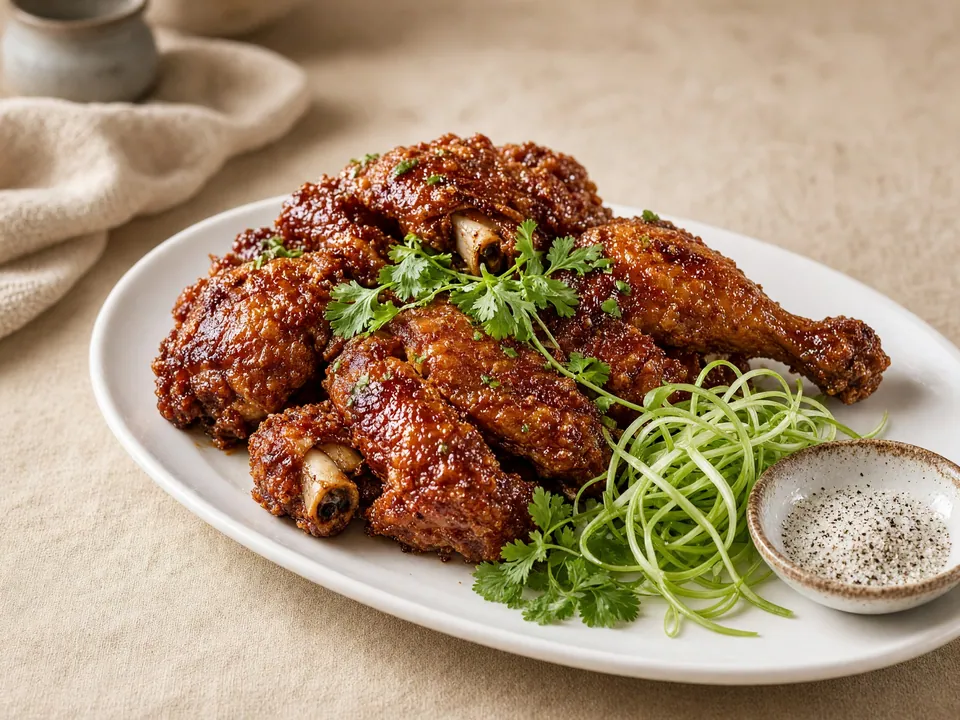
Zhaziji is Cantonese banquet cooking at its most direct: a whole chicken is gently poached in a ginger-and-anise brine, brushed with maltose, air-dried and then bathed in hot oil until the skin turns a deep lacquered red. It appears at wedding banquets and Lunar New Year tables across Guangdong, and the same bird belongs to Dongjiang Hakka kitchens. The meat stays silky and juicy while the skin shatters — clean, savoury, with a faint sweetness.
Cantonese Crispy Fried Chicken (Zhaziji)
炸子鸡, Zhà zǐ jī
Pronounced jah-dzuh-JEE
- Serves
- 4
- Prep
- 25 min
- Cook
- 50 min
- Total
- 1 hr 15 min
- Level
- Medium
Also nut-free and egg-free.
Allergens: none of the major allergens in the listed ingredients. Check labels on packaged ingredients.
Ingredients
Amounts are scaled. Cooking times and pan sizes stay the same.
Chicken
Poaching brine
Glaze
For frying
Method
Trim the chicken of excess fat, the parson's nose and any stray feathers, then rinse and pat it very dry inside and out. Rub the 2 tsp salt, the five-spice and 1 tbsp wine all over the skin and into the cavity, and leave it at room temperature for 20 minutes.
Put the water, 1/4 cup salt, ginger, scallions, star anise and 1 tbsp wine into a pot just wide enough to hold the chicken. Bring to a boil, then drop to a bare simmer for 10 minutes so the aromatics release their flavour.
Hold the chicken by the neck and dip it into the simmering brine three times, letting it drain between dips, so the skin tightens and darkens slightly. Lower it in breast-side down and keep the liquid at a bare simmer — small bubbles only, never a rolling boil — for 12 minutes.
Turn the chicken over and poach for another 8–10 minutes, until the leg joint moves freely and a thermometer in the thickest part of the thigh reads 165°F (74°C). Lift it out and let it drain and cool in a colander for 30 minutes.
Warm the maltose, rice vinegar and hot water together, stirring until completely smooth. Brush this glaze thinly and evenly over the whole bird while it is still slightly warm.
Hang the chicken from a hook over a tray, or set it on a rack in front of a fan, and let it dry for 2–3 hours, until the skin feels dry and tacky rather than wet.
Heat the oil in a wok to 350°F (175°C). Holding the chicken over the oil on a long-handled hook or in a slotted ladle, spoon hot oil over it continuously, turning as you go, for 5–7 minutes, until the skin is deep mahogany-red, blistered and crisp.
If your wok is deep enough, lower the bird into the oil for the final 2 minutes to crisp the underside. Rest it for 10 minutes, then chop through the bone into bite-size pieces with a heavy cleaver and reassemble the pieces on a platter.
Regional variant: Dongjiang Crispy Chicken (Dongjiang Zhaziji, 东江炸子鸡)
The Hakka version jointing the bird instead of cooking it whole: cut the chicken into large bone-in pieces and marinate them for 1 hour with salt, five-spice, grated ginger, scallion and Shaoxing wine. Drain, dust generously with cornstarch (some cooks use a thin egg-and-flour batter instead), then deep-fry at 340°F (170°C) for 6–8 minutes until golden, lift out, raise the oil to 375°F (190°C) and fry again for 1 minute to crisp. Serve with a dip of salt and white pepper.
Cook's notes
- Keep the poaching liquid: strain it, skim the fat, and you have a light, fragrant broth for noodles the next day.
- Dry skin is everything — a wet bird steams instead of crisping. If you are short of time, leave it uncovered in the fridge overnight.
- Chop and serve within half an hour; the crackle of the skin fades quickly once the chicken is cold.
Serve with
Chopped and piled on a platter with a dish of salt and white pepper, steamed jasmine rice and blanched greens; or with hot mustard and a bowl of the poaching broth.
Make ahead and storage
Poach, glaze and dry the chicken up to a day ahead and keep it uncovered in the fridge; fry just before serving. Leftovers keep 2 days refrigerated and are excellent eaten cold.