Cantonese Shrimp Dumplings (Har Gow / Xiājiǎo)
虾饺 xiājiǎo (Cantonese: hā gáau)Say it: shyah-JYOW (Cantonese: hah-GOW)
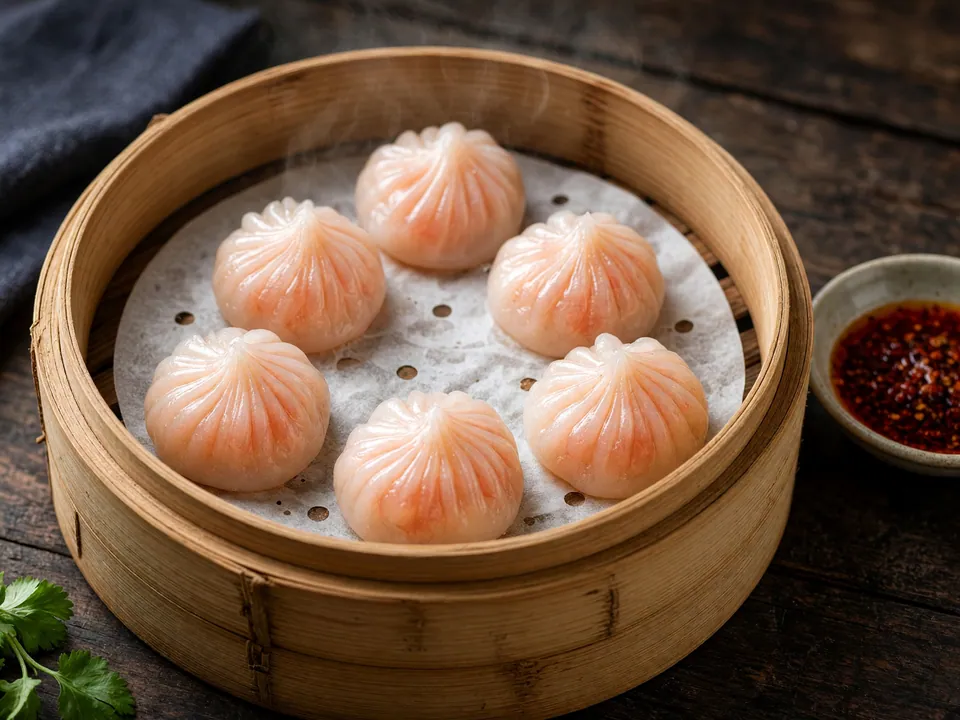
Har gow is the benchmark of Cantonese dim sum: a plump shrimp filling wrapped in a thin, translucent skin that is pleated into a small crescent and steamed until it shines. In Guangdong teahouses it arrives in bamboo baskets with a pot of tea, usually alongside siu mai and cheung fun. The wrapper is chewy and slightly sticky, the filling sweet and juicy with a snap of bamboo shoot, seasoned only with salt, sugar, white pepper and sesame oil.
Cantonese Shrimp Dumplings (Har Gow / Xiājiǎo)
虾饺, xiājiǎo (Cantonese: hā gáau)
Pronounced shyah-JYOW (Cantonese: hah-GOW)
- Serves
- 4
- Prep
- 45 min
- Cook
- 15 min
- Total
- 1 hr
- Level
- Advanced
Also nut-free and egg-free.
Allergens: contains shellfish, gluten, sesame. Check labels on packaged ingredients.
Ingredients
Amounts are scaled. Cooking times and pan sizes stay the same.
Shrimp filling
Translucent dough
Method
Pat the shrimp very dry. Chop about two-thirds of them to a coarse paste and cut the rest into 1/2-inch (1 cm) pieces; put everything in a bowl with the sugar, salt, white pepper, rice wine, sesame oil and cornstarch.
Stir the filling hard in one direction for about 2 minutes, until it turns sticky and clumps together, then fold in the bamboo shoot and the lard. Cover and chill for 30 minutes — cold filling is far easier to wrap.
For the dough, whisk the wheat starch and tapioca starch in a heatproof bowl. Pour in the boiling water all at once and stir vigorously with chopsticks until it forms a shaggy, translucent mass, then cover the bowl with a plate and let it stand 2 minutes.
Tip the warm dough onto a lightly oiled surface and knead in the lard until smooth, supple and no longer sticky, about 3 minutes; if it crumbles, wet your hands with hot water and keep going. Wrap the dough tightly, because it must stay warm to be workable.
Roll the dough into a log and cut it into 24 even pieces, keeping them under a damp cloth. Oil a flat knife blade or dough scraper and press each piece into a thin 3-inch (8 cm) round, or roll it between two sheets of oiled parchment, leaving the rim thinner than the centre.
Cup a wrapper in your palm, set a heaped teaspoon (about 15 g) of chilled filling in the middle, and pleat one edge into 7–9 small folds, pinching the seam firmly shut into a crescent. Tap each dumpling, curved side up, on the bench so the base sits flat, then repeat with the rest.
Line a bamboo steamer with parchment punched with holes (or a cabbage leaf) and oil it lightly. Set the dumplings in 1 inch (2.5 cm) apart and steam over rapidly boiling water for 6–7 minutes, until the wrappers turn glassy and the pink shrimp shows through.
Lift the basket off the pot and serve immediately, while the skins are still supple and the filling hot and juicy.
Regional variants
Some kitchens add a little minced pork fat or a few chopped scallions to the filling for extra richness. In Chaozhou, the same glassy dough is used for fun guo, a related dumpling filled with peanuts, dried shrimp, pork and mushrooms.
Cook's notes
- Keep the dough warm and every piece covered as you work; once wheat-starch dough cools it cracks and will not pleat.
- Steam one dumpling first as a test: if the skin splits, the dough was too dry (knead in a few drops of hot water) or the filling too wet.
- Use a light hand with the filling — an overfilled dumpling bursts before the shrimp is cooked through.
Serve with
A pot of strong pu-erh or jasmine tea, with chili oil or light soy sauce for dipping.
Make ahead and storage
Pleat the dumplings up to 4 hours ahead, cover and refrigerate on a lined tray, then steam straight from the fridge with 1 extra minute; once steamed they are best eaten at once.