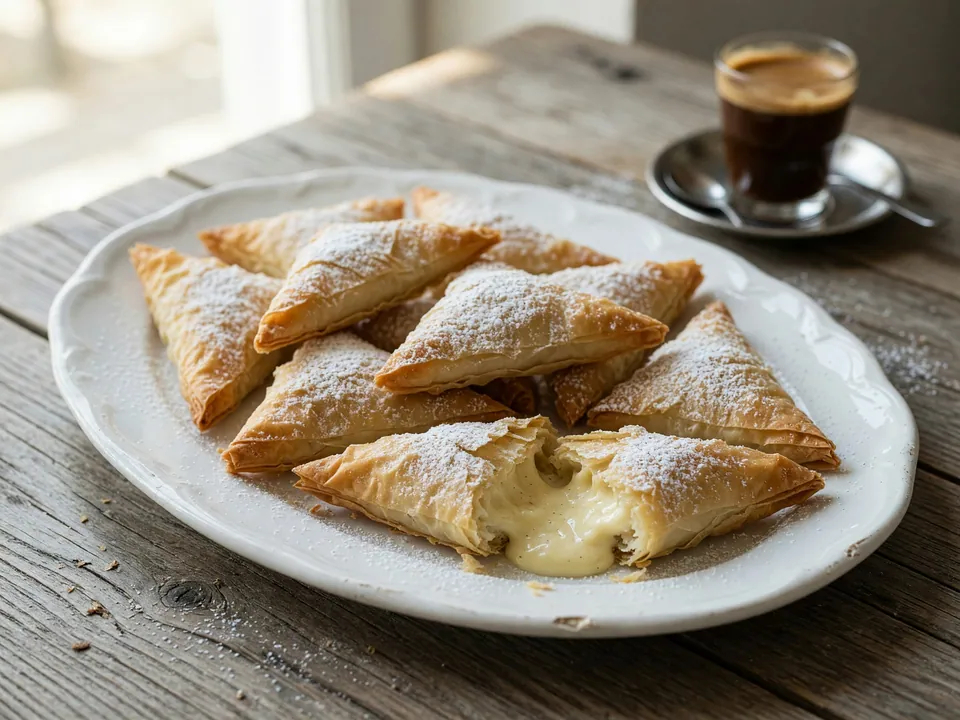
Russian Napoleon Cake (Tort Napoleon)
Торт «Наполеон» Tort NapoleonSay it: tort nah-pah-lee-OHN
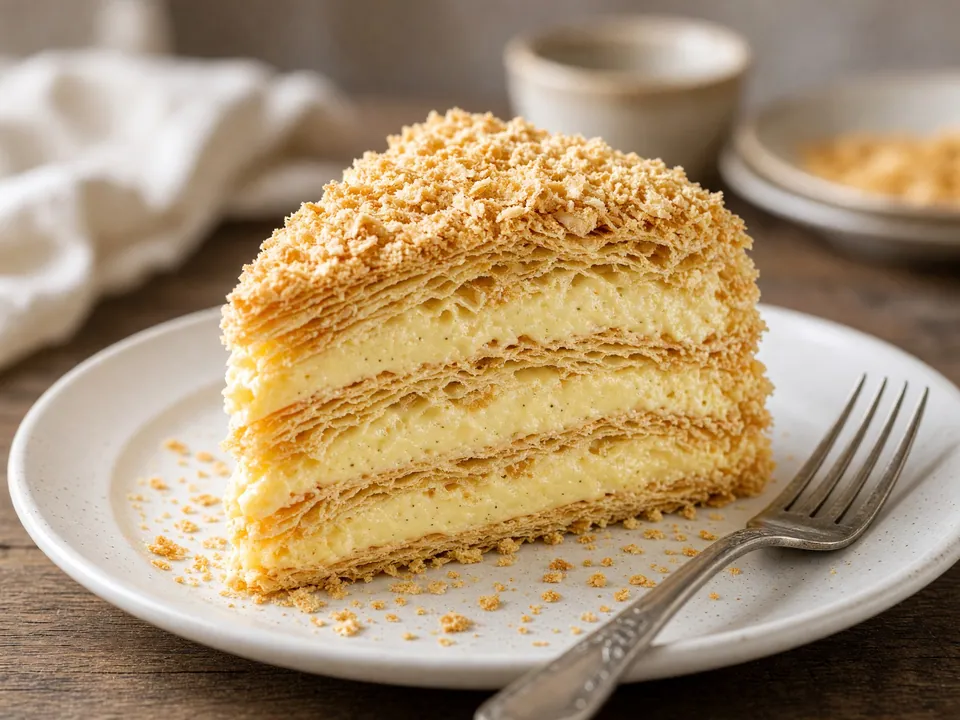
Napoleon cake is Russia's beloved layered dessert: dozens of paper-thin puff pastry sheets sandwiched with silky vanilla custard. It is traditionally made for New Year, birthdays, and family celebrations, then chilled until the crisp layers soften into a tender, sliceable cake. The flavor is rich but balanced—buttery pastry, sweet milky custard, and a crumb coating made from baked pastry trimmings. Each slice is creamy, delicate, and faintly tangy from the simple dough.
Russian Napoleon Cake (Tort Napoleon)
Торт «Наполеон», Tort Napoleon
Pronounced tort nah-pah-lee-OHN
- Serves
- 10
- Prep
- 1 hr
- Cook
- 1 hr
- Total
- 2 hr
- Level
- Medium
Also nut-free.
Allergens: contains gluten, milk, egg. Check labels on packaged ingredients.
Ingredients
Amounts are scaled. Cooking times and pan sizes stay the same.
For the pastry
For the custard
For finishing
Method
Make the dough. whisk 3 1/2 cups (440 g) flour and 1/2 tsp salt in a large bowl. Add the cubed cold butter and toss to coat, then rub it in with your fingertips until the mixture looks like coarse crumbs with some pea-sized butter pieces left. Whisk the egg, ice water, and vinegar in a small bowl, pour over the flour, and stir with a fork until a shaggy dough forms.
Gather the dough into a ball without kneading, flatten into a disk, wrap, and refrigerate for at least 1 hour or up to 1 day.
Divide the chilled dough into 12 equal pieces, about 2 1/2 oz (70 g) each. Shape each into a small disk, then roll one piece at a time on a lightly floured surface into a 9-inch (23 cm) round, about 1/8 inch (3 mm) thick. Prick all over with a fork and transfer to a parchment-lined baking sheet.
Bake at 400°F (200°C) for 6-8 minutes, until golden and the edges crisp, baking one or two rounds per sheet. Transfer to a rack to cool completely and repeat with the remaining dough, saving all trimmings.
While the layers bake, make the custard. heat the milk in a saucepan over medium heat until steaming but not boiling. In a bowl, whisk the sugar, 1/2 cup (60 g) flour, 1/8 tsp salt, and egg yolks until smooth and pale. Slowly whisk in about 1 cup of the hot milk, then pour the yolk mixture back into the saucepan.
Cook over medium heat, whisking constantly, until the custard thickens and bubbles gently, 4-6 minutes. Remove from heat and whisk in the softened butter and vanilla until glossy and smooth. Scrape into a bowl, press plastic wrap onto the surface, and cool to room temperature.
Crush the cooled pastry trimmings into coarse crumbs. Place one pastry round on a serving plate and spread with about 1/3 cup (80 ml) custard; repeat with the remaining rounds, stacking as you go and finishing with a pastry round.
Spread the remaining custard over the top and sides, then press the pastry crumbs onto the top and sides, covering the cake. Refrigerate uncovered for 1 hour to set the coating, then cover and chill at least 6 hours or overnight, until the layers soften and the cake slices cleanly.
Regional variants
Some modern versions add a layer of whipped cream or fresh berries, and many home cooks use ready-made all-butter puff pastry for a quicker cake.
Cook's notes
- For even layers, weigh the dough pieces and use a plate or cake pan as a template when trimming the rounds.
- Don't skip the overnight chill; the cake needs time for the crisp pastry to soften and the custard to set.
- If the dough becomes warm or sticky while rolling, return it to the refrigerator for 10-15 minutes.
Serve with
Serve chilled with tea or coffee; fresh berries on the side are optional.
Make ahead and storage
The cake improves overnight and keeps covered in the refrigerator for up to 3 days; let it stand at room temperature for 20 minutes before slicing.