Thessaloniki Custard Triangles (Trigona Panoramatos)
Τρίγωνα Πανοράματος Trígona PanorámatosSay it: TREE-gho-nah pah-noh-RAH-mah-tos
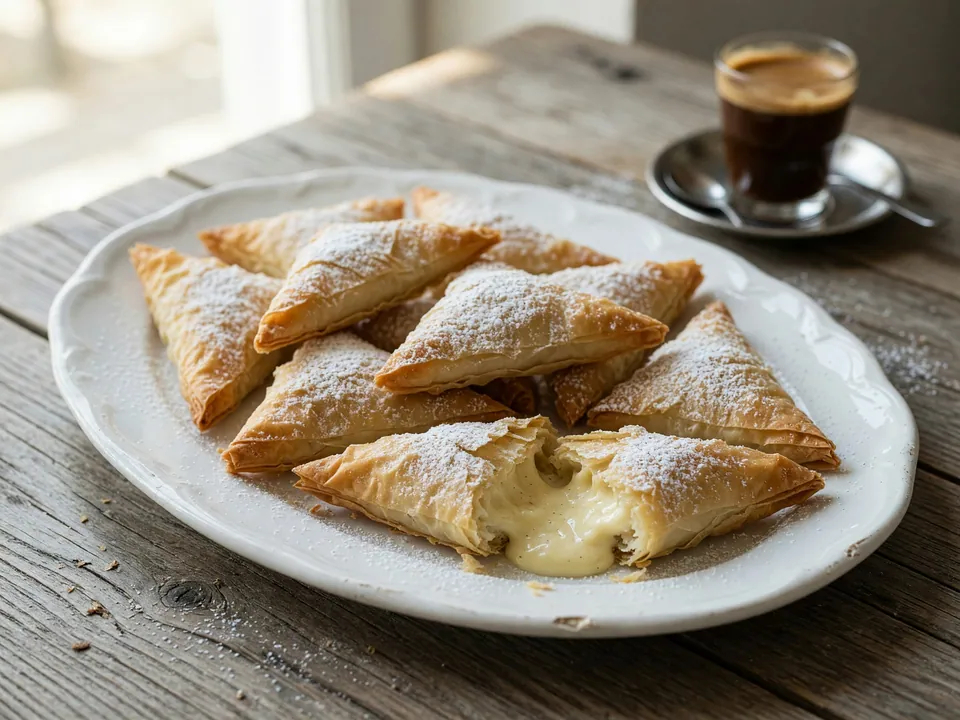
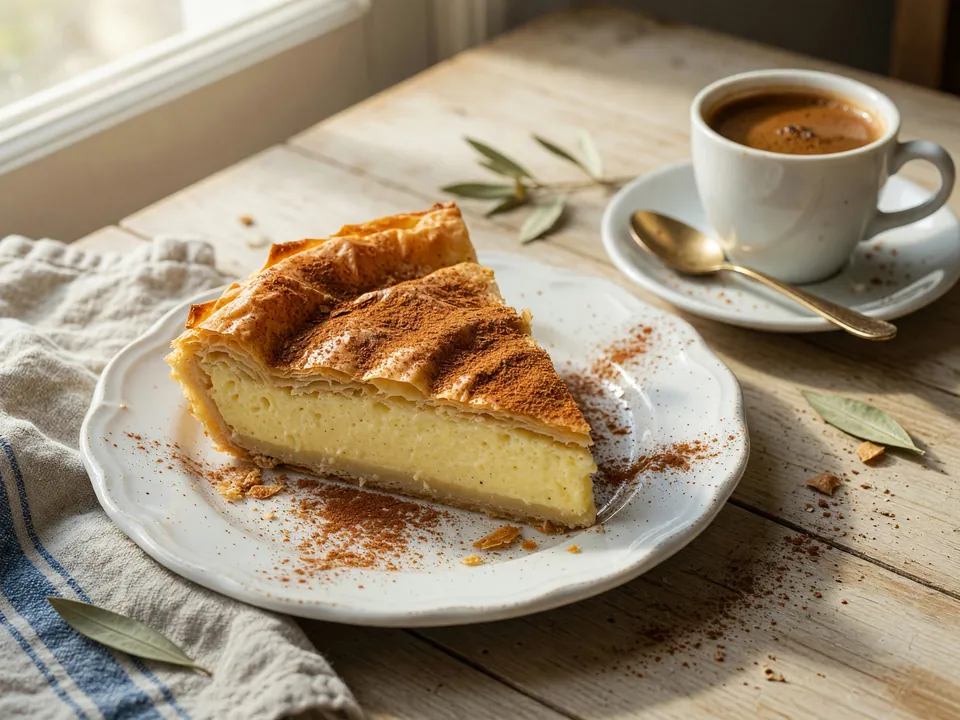
These crisp, golden phyllo triangles are the signature sweet of Panorama, a hillside suburb of Thessaloniki in northern Greece. Baked until shatteringly crisp, the buttery pastry is filled with a thick, cool vanilla custard and dusted with powdered sugar. They are a beloved afternoon treat with Greek coffee, balancing delicate crackly layers with a rich, creamy centre. Unlike syrup-soaked Greek pastries, trigona stay dry and crisp, which makes the contrast between shell and filling the whole point of the dessert.
Thessaloniki Custard Triangles (Trigona Panoramatos)
Τρίγωνα Πανοράματος, Trígona Panorámatos
Pronounced TREE-gho-nah pah-noh-RAH-mah-tos
- Serves
- 12
- Prep
- 45 min
- Cook
- 25 min
- Total
- 1 hr 10 min
- Level
- Medium
Also nut-free.
Allergens: contains gluten, milk, egg. Check labels on packaged ingredients.
Ingredients
Amounts are scaled. Cooking times and pan sizes stay the same.
For the phyllo triangles
For the custard filling
Method
Make the custard. in a medium saucepan, whisk together the sugar, cornstarch and egg yolks until smooth. Whisk in the milk and place over medium heat.
Cook, whisking constantly, until the mixture thickens and just begins to bubble, about 5–7 minutes. Remove from the heat and whisk in the vanilla and 1 tbsp butter until smooth. Transfer to a bowl, press plastic wrap directly onto the surface, and cool completely, then refrigerate until cold and firm.
Heat the oven to 350°F (175°C). Line a baking sheet with parchment paper. Unroll the phyllo and keep it covered with a barely damp kitchen towel so it does not dry out.
Brush one phyllo sheet lightly with melted butter, place a second sheet on top, brush again, add a third sheet and brush again. Cut the stack lengthwise into 6 strips, each about 2 inches (5 cm) wide. Repeat with the remaining 3 sheets and remaining butter, so you have 12 strips total.
If you have small conical cream horn moulds (or triangular ones if available), butter them lightly. Otherwise make 12 foil cones: cut 5-inch (12 cm) squares of aluminium foil, fold each into a triangle, then roll to form a narrow cone, crimping the seam to hold.
Working with one strip at a time, starting at the pointed end, wrap the strip around a mould in a spiral, brushing with a little butter as you go and overlapping each turn by about half the strip's width. Tuck the last bit under at the wide end. Place seam-side down on the baking sheet.
Bake for 15–20 minutes until deep golden and crisp. Let the pastries cool on the baking sheet for 5 minutes, then gently slide out the moulds. Cool completely on a wire rack.
Spoon the cold custard into a piping bag fitted with a plain round tip. Pipe the custard into each hollow pastry until full, piping from the wide end.
Dust generously with powdered sugar and serve immediately, or refrigerate for up to 2 hours before serving.
Regional variants
Some Thessaloniki pastry shops fill trigona with chocolate pastry cream or top them with a spoonful of whipped cream; modern versions occasionally use kataifi pastry instead of phyllo.
Cook's notes
- Keep phyllo covered and work quickly: it dries out and cracks within minutes, making it hard to wrap.
- Traditional trigona are made on triangular moulds; round cone moulds produce the same crisp, filled pastry with a slightly different shape.
- For extra shine, you can brush the baked pastries with a little warm honey syrup before filling, though the classic version is dry and crisp.
Serve with
Serve with Greek coffee or a glass of cold milk.
Make ahead and storage
Baked unfilled shells keep for 1 day in an airtight container at room temperature; fill no more than 2 hours before serving or the pastry softens.