California Sourdough Bread
California Sourdough Bread Say it: kal-ih-FOR-nee-uh SOW-ur-doh bred
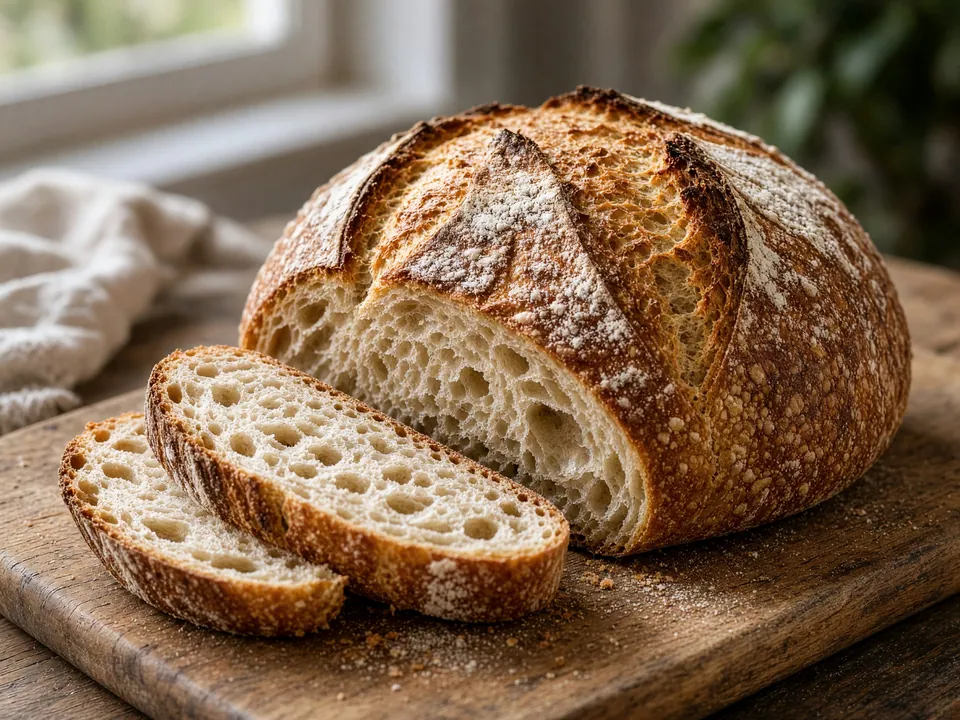
California sourdough bread, especially the San Francisco style, is a crusty, chewy loaf with a crackling crust and a gently tangy crumb. It is everyday bread in the Bay Area, served with butter, used for sandwiches, and toasted for breakfast. A bubbly starter, long fermentation, and a hot Dutch oven create its blistered crust and open, custardy interior. It tastes wheaty and sour, never sharply acidic.
California Sourdough Bread
California Sourdough Bread
Pronounced kal-ih-FOR-nee-uh SOW-ur-doh bred
- Serves
- 4
- Prep
- 30 min
- Cook
- 45 min
- Total
- 1 hr 15 min
- Level
- Medium
Also nut-free and egg-free.
Allergens: contains gluten. Check labels on packaged ingredients.
Ingredients
Amounts are scaled. Cooking times and pan sizes stay the same.
Dough
Method
Feed the starter 6-8 hours before mixing, or use it when it is bubbly, domed, and doubles within 4-6 hours of a feeding.
In a large bowl, whisk the bread flour and water until no dry flour remains. Cover and rest 30 minutes to hydrate the flour.
Add the starter and salt. Pinch and squeeze the dough until the starter is fully incorporated and the dough feels cohesive, about 3 minutes. Scrape down the bowl.
Cover and let rise at room temperature (about 75°F/24°C). After 30 minutes, perform a set of stretch-and-folds: lift one side of the dough, stretch it up, and fold it over the center. Rotate the bowl and repeat around the dough. Repeat every 30 minutes for 2 hours (4 sets total), until the dough is smooth and holds a soft shape.
Continue bulk fermentation 2-4 hours more, until the dough has risen by 50-75%, looks domed, and shows bubbles at the edges. It should feel airy but still have strength.
Turn the dough onto a lightly floured counter. Pat into a rough rectangle, fold the left and right sides into the center, then roll from the top toward you into a loose round. Cover and rest 20 minutes.
Shape again into a tight boule. flour the top, flip seam-side up, fold the edges into the center, then drag the dough on the counter to build tension. Place seam-side up in a floured proofing basket or a bowl lined with a floured towel.
Cover and refrigerate 12-18 hours. The dough should look puffy and feel cool and firm, not collapsed.
Place a Dutch oven with lid in the oven and preheat to 500°F (260°C) for 45 minutes. Turn the dough out onto parchment, score a shallow slash or cross, and lower it into the hot pot. Cover, reduce to 475°F (245°C), and bake 20 minutes.
Carefully remove the lid and bake 20-25 minutes more, until deep golden brown and the crust sounds hollow when tapped. Cool on a wire rack at least 1 hour before slicing; the crumb finishes setting as it cools.
Regional variants
Some bakers replace up to 20% of the bread flour with whole-wheat or rye for a darker, more complex loaf, or shape the dough into a long batard for sandwiches.
Cook's notes
- Use a starter at its peak: bubbly, domed, and doubled 4-6 hours after feeding. A flat or sharply acetone-smelling starter will make the loaf sour but slow to rise.
- Judge bulk fermentation by feel as well as time: the dough should be puffy, jiggly, and leave a slow, partial spring when poked with a floured finger.
- Bake the loaf fully: a deep brown crust and hollow tap sound mean the interior is set; slicing hot gives a gummy crumb.
Serve with
Butter, olive oil, or alongside clam chowder; also ideal for sandwiches and toast.
Make ahead and storage
The dough can be cold-retarded up to 24 hours; baked bread keeps cut-side down at room temperature for 2 days or freezes sliced for 3 months. Refresh in a 350°F (175°C) oven.