Central Texas-Style Barbecue
Central Texas-Style Barbecue Say it: SEN-trul TEK-sus STAHYL BAR-bih-kyoo
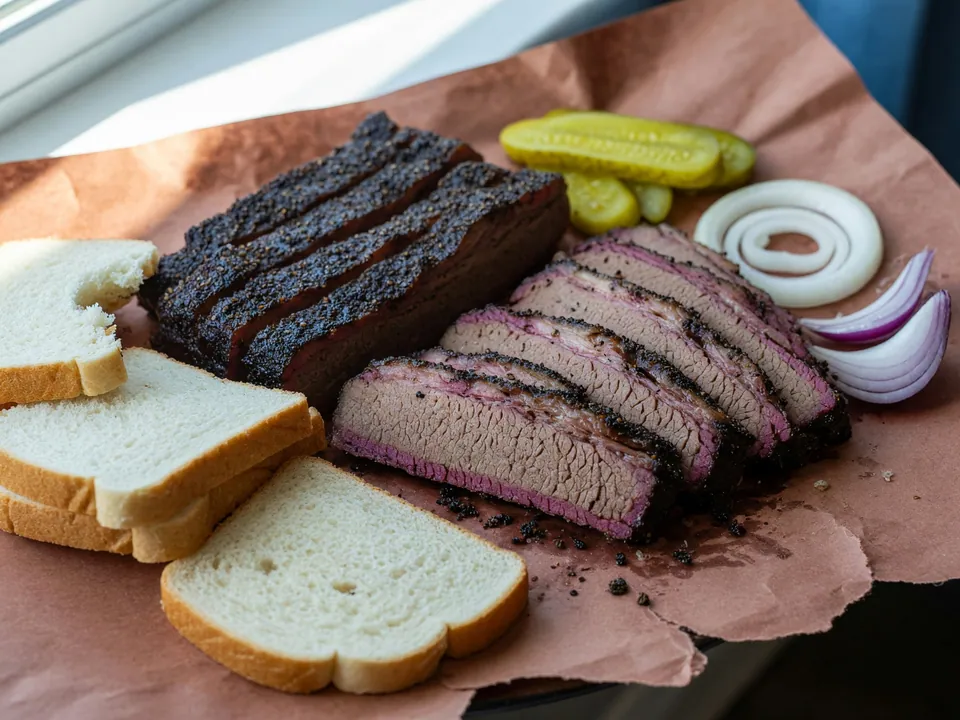
Central Texas-style barbecue is built around one cut: a whole beef brisket, rubbed with only coarse salt and black pepper and smoked low and slow over post oak. The result is a deep, dark peppery bark, a rosy smoke ring, and beef so tender it nearly melts. Traditionally served at weekend gatherings and barbecue joints across the Texas Hill Country, it is often sliced thin and piled onto butcher paper with white bread, pickles, and onions. This recipe focuses on the iconic smoked brisket.
Central Texas-Style Barbecue
Central Texas-Style Barbecue
Pronounced SEN-trul TEK-sus STAHYL BAR-bih-kyoo
- Serves
- 8
- Prep
- 30 min
- Cook
- 12 hr
- Total
- 12 hr 30 min
- Level
- Advanced
Also nut-free and egg-free.
Allergens: none of the major allergens in the listed ingredients. Check labels on packaged ingredients.
Ingredients
Amounts are scaled. Cooking times and pan sizes stay the same.
Method
Trim the brisket. place the packer on a cutting board and use a sharp knife to trim the fat cap to an even 1/4 inch (6 mm) thickness. Remove any hard fat, silver skin, and thin edges that will burn. Leave the soft fat over the point for moisture.
In a small bowl, mix the kosher salt and coarse-ground black pepper. Sprinkle the rub generously over the entire brisket and press it into the meat; do not rub it off. Let the brisket sit at room temperature while you heat the smoker, about 30-45 minutes.
Preheat a smoker to 250°F (120°C) using post oak or another oak wood; you want a thin, clean smoke. Set the brisket on the grate fat side up with the thicker point end facing the heat source.
Smoke the brisket with the lid closed, maintaining 225-275°F (107-135°C), until the internal temperature reaches 165-170°F (74-77°C) and the bark is dark and set, about 6-8 hours. If the edges look dry, spritz lightly with water.
Lay out two large sheets of unwaxed butcher paper or heavy-duty foil. Place the brisket in the center, wrap it tightly, and return it to the smoker or a 250°F (120°C) oven. Continue cooking until a probe slides into the flat with almost no resistance, usually between 195-205°F (90-96°C), about 4-6 hours more.
Keep the brisket wrapped and rest it in a dry cooler or wrapped in towels for at least 1 hour, preferably 2-3 hours, until the internal temperature eases to 140-150°F (60-65°C). This step is essential for juicy slices.
Unwrap the brisket, separate the point and flat, and slice the flat against the grain into 1/4 inch (6 mm) thick slices. Slice or chop the point as desired, and serve immediately with classic sides.
Regional variants
Some cooks add a thin, tomato-vinegar sauce on the side, and East Texas barbecue leans toward chopped beef sandwiches with a sweeter, thicker sauce.
Cook's notes
- Use a leave-in probe thermometer for both the pit and the meat; ambient temperature swings are common in small smokers.
- If you can't find post oak, use any oak or a blend of oak and a little hickory; avoid mesquite, which can overpower beef.
- Butcher paper lets the bark breathe better than foil; foil traps steam and softens the crust, but still works in a pinch.
Serve with
Sliced white bread, dill pickle slices, raw onion, pickled jalapeños, and cold beer or sweet tea.
Make ahead and storage
Wrap leftovers tightly and refrigerate up to 4 days; reheat gently in a covered pan with a splash of beef broth or wrap in foil with a little beef tallow in a 300°F (150°C) oven.