Roulé hongrois aux graines de pavot et aux noix (Bejgli)
Bejgli Dites-le : BAY-glee
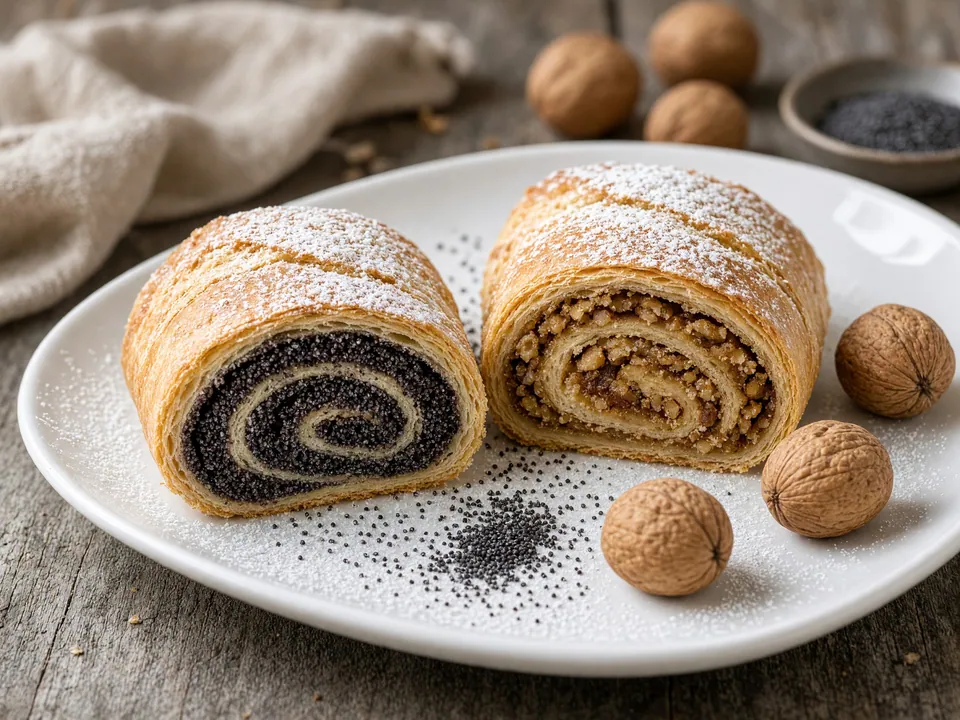
Le bejgli est une pâtisserie levée roulée hongroise bien-aimée, traditionnellement servie à Noël et à Pâques. La pâte douce et légèrement sucrée est garnie soit d'une riche pâte de graines de pavot, soit d'une garniture sucrée aux noix, puis cuite jusqu'à ce qu'elle soit dorée. Son beau motif en spirale une fois tranché en fait un dessert à la fois festif et réconfortant. Les familles préparent souvent les deux garnitures pour que chacun puisse profiter de sa préférée, et les roulés sont offerts en cadeau ou placés sur la table des fêtes aux côtés d'autres douceurs.
Roulé hongrois aux graines de pavot et aux noix (Bejgli)
Bejgli
Prononcé BAY-glee
- Pour
- 6
- Préparation
- 45 min
- Cuisson
- 35 min
- Total
- 1 h 20 min
- Niveau
- Moyen
Allergènes : contient gluten, lait, œuf, noix. Vérifiez les étiquettes des ingrédients emballés.
Ingrédients
Les quantités sont ajustées. Les temps de cuisson et les tailles de plats restent les mêmes.
Dough
Poppy Seed Filling (makes one roll)
Walnut Filling (makes one roll)
For finishing
Méthode
Dissolve the yeast in the lukewarm milk with a pinch of sugar and let it stand for 5-10 minutes until foamy.
In a large bowl, combine the flour, sugar, salt, and lemon zest. Add the softened butter, eggs, and yeast mixture. Knead until a smooth, soft dough forms, about 8-10 minutes. Cover and let rise in a warm place for 1 hour or until doubled.
While the dough rises, prepare the fillings. For poppy seed: simmer the milk, sugar, and honey, then stir in the ground poppy seeds, vanilla, and lemon zest. Cook until thickened, about 5 minutes. Cool completely. Repeat the same process for the walnut filling using ground walnuts and cinnamon.
Divide the risen dough into two equal pieces. On a lightly floured surface, roll each piece into a 12x16-inch (30x40 cm) rectangle about 1/4 inch (6 mm) thick.
Spread one rectangle evenly with the cooled poppy seed filling, leaving a 1-inch (2.5 cm) border. Roll tightly from the long side, tucking the ends under. Repeat with the second rectangle and walnut filling.
Place both rolls seam-side down on a parchment-lined baking sheet. Brush generously with the egg wash. Let them rest for 20 minutes while the oven preheats to 350°F (175°C).
Brush again with egg wash. Using a fork or toothpick, poke small holes along the top of each roll to prevent cracking.
Bake for 30-35 minutes until deep golden brown and the rolls sound hollow when tapped. Cool completely on a wire rack before slicing.
Slice into 1/2-inch (1 cm) pieces to show the beautiful spiral pattern.
Variantes régionales
Some families add a handful of raisins or chopped dried apricots to the walnut filling. A modern twist replaces half the poppy seeds with ground almonds for a milder flavor.
Notes du cuisinier
- Grind your own poppy seeds and walnuts fresh for the best flavor and texture.
- The fillings should be thick and spreadable but not runny; add a splash more milk if too dry or a few tablespoons of breadcrumbs if too loose.
- Traditional bejgli develops a slight crack on top during baking; this is considered a sign of authenticity.
Servir avec
Serve at room temperature with coffee, tea, or a glass of sweet Hungarian wine.
Préparation à l'avance et conservation
Bejgli keeps well for up to 5 days wrapped in foil at room temperature. It also freezes beautifully for up to 2 months; thaw overnight before serving.