Portugiesische Vanillecreme-Gebäckstücke (Pastel de Tentúgal)
Pastel de Tentúgal Aussprache: pash-TEL de ten-TOO-gahl

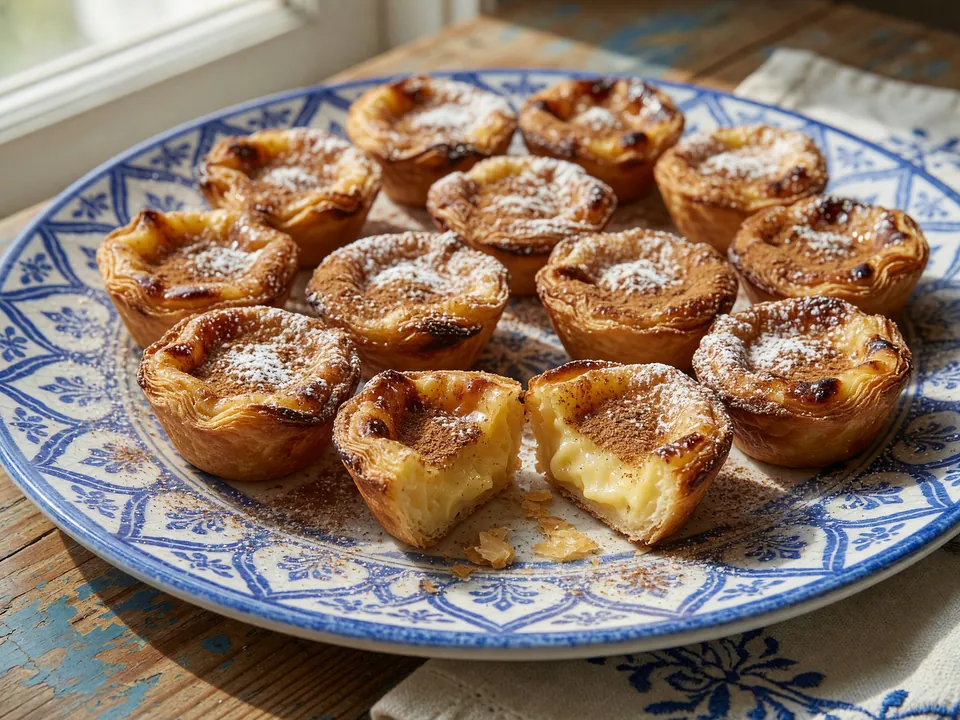
Pastel de Tentúgal ist ein zartes, knuspriges Gebäck aus dem kleinen Dorf Tentúgal im zentralen Portugal. Es wird aus papierdünnem, gestrecktem Teig ähnlich wie Filo hergestellt, mit einer reichhaltigen Eigelb-Vanillecreme gefüllt und mit einer Bestäubung von Zimt und Puderzucker fertiggestellt. Traditionell im 16. Jahrhundert von Nonnen gebacken, werden diese Gebäckstücke noch immer handgefertigt in lokalen Klöstern und Bäckereien. Sie bieten einen wunderbaren Kontrast aus splitternd knusprigen Schichten und seidig süßer Füllung und werden als besonderer Nachmittagssnack mit Kaffee genossen.
Portugiesische Vanillecreme-Gebäckstücke (Pastel de Tentúgal)
Pastel de Tentúgal
Aussprache pash-TEL de ten-TOO-gahl
- Für
- 8
- Vorbereitung
- 1 Std.
- Zubereitung
- 25 Min.
- Gesamt
- 1 Std. 25 Min.
- Schwierigkeitsgrad
- Fortgeschritten
Auch nussfrei.
Allergene: enthält gluten, milch, ei. Etiketten auf verpackten Zutaten prüfen.
Zutaten
Mengen wurden angepasst. Kochzeiten und Pfannengrößen bleiben gleich.
Custard Filling
To Finish
Zubereitung
Make the dough. In a large bowl, mix 2 1/4 cups (280 g) flour and salt. Add warm water and olive oil; stir until a soft dough forms. Knead on a lightly floured surface for 5 minutes until smooth and elastic. Wrap in plastic and rest at room temperature for 30 minutes.
Prepare the syrup. In a small saucepan, combine sugar, water, cinnamon stick, and lemon peel. Bring to a boil and simmer 5 minutes until slightly thickened. Remove from heat, discard cinnamon and peel, and set aside to cool.
Make the custard. In a bowl, whisk flour with 1/2 cup (120 ml) of the milk until smooth. Heat the remaining milk in a saucepan until just simmering. Whisk the hot milk into the flour mixture, return to the pan, and cook over medium heat, stirring constantly, until thickened like pudding, about 3 minutes.
Temper the yolks. Whisk the egg yolks in a bowl. Slowly pour the cooled syrup into the yolks while whisking vigorously. Add this mixture to the thickened milk, stirring constantly over low heat until it thickens again and reaches 175°F (80°C). Do not boil. Remove from heat, stir in vanilla, and strain through a fine sieve. Cool completely.
Stretch the dough. Divide rested dough into 4 pieces. On a large, lightly floured table covered with a clean cloth, roll and then stretch each piece by hand into an extremely thin, almost transparent sheet about 20 x 15 inches (50 x 38 cm). Brush generously with melted butter as you work. Let the sheets air-dry for 10 minutes until slightly leathery.
Assemble the pastries. Preheat oven to 400°F (200°C). Cut each dough sheet into 8 rectangles. Place a heaping tablespoon of cooled custard in the center of each. Fold the long sides over the filling, then roll from a short side into a compact cylinder, tucking in the ends. Place seam-side down on a parchment-lined baking sheet.
Bake until the pastries are deep golden brown and the edges look crisp and flaky, 20–25 minutes. Rotate the tray halfway through for even browning.
Cool the pastries on a wire rack for 10 minutes. Generously dust with powdered sugar and a light sprinkle of ground cinnamon while still warm.
Regionale Varianten
Some modern versions add a touch of orange zest to the custard or use a puff-pastry shortcut, though these lack the signature paper-thin layers of the traditional stretched dough.
Tipps des Kochs
- Work quickly when stretching the dough; it dries out fast. Keep unused sheets covered with a lightly damp cloth.
- The custard should be quite thick so it does not leak during baking; chill it thoroughly before filling.
- For the most authentic shatteringly crisp texture, serve the same day they are baked.
Dazu servieren
Strong Portuguese espresso or a glass of sweet Port wine.
Vorbereiten und Aufbewahren
The custard can be made 1 day ahead and refrigerated. Baked pastries are best fresh but can be stored in an airtight container for 1 day and reheated briefly in a hot oven to restore crispness.