Slovenian Rolled Nut Cake (Potica)
Potica Say it: poh-TEET-sah
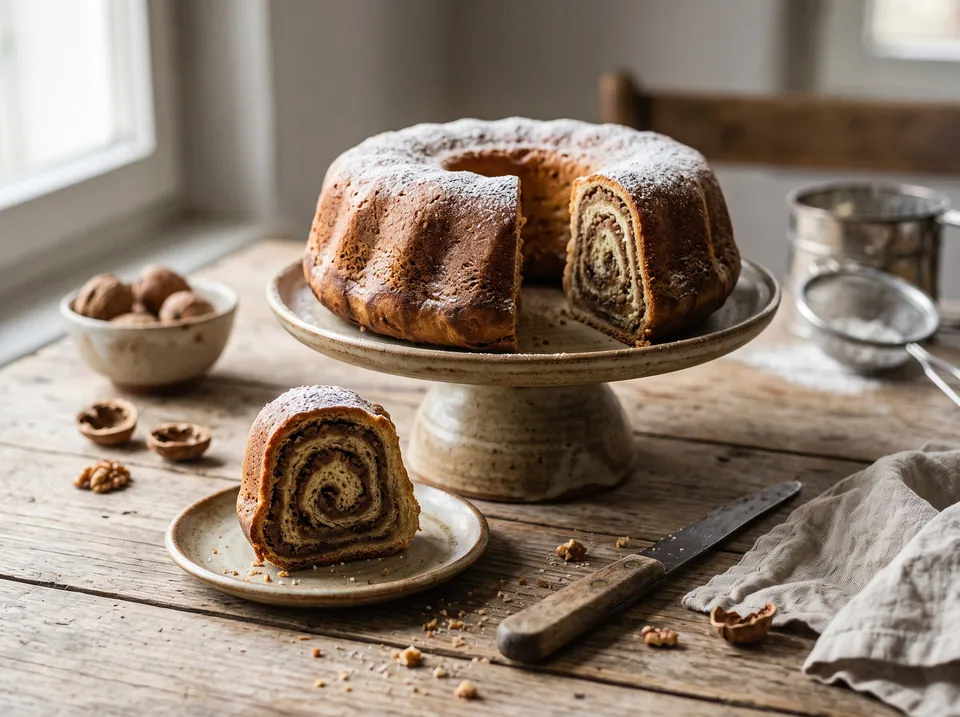
Potica is Slovenia’s signature celebration cake, served at Easter and Christmas and also at weddings and family gatherings. A supple yeast dough is stretched until nearly translucent, covered with a dark walnut filling and rolled into a ring, so every cut slice shows a clean spiral. The flavor is nutty and honeyed with a faint cinnamon note, and the name comes from poviti, 'to wrap or roll'; walnut remains the best-known filling. Because the ring is substantial, plan on thin slices.
Slovenian Rolled Nut Cake (Potica)
Potica
Pronounced poh-TEET-sah
- Serves
- 12
- Prep
- 45 min
- Cook
- 1 hr
- Total
- 1 hr 45 min
- Level
- Advanced
Allergens: contains gluten, milk, egg, nuts. Check labels on packaged ingredients.
Ingredients
Amounts are scaled. Cooking times and pan sizes stay the same.
Dough
Walnut Filling
To Finish
Method
Crumble the yeast into a cup with 1 teaspoon of the sugar and the lukewarm milk, then stir and leave for about 10 minutes; it should turn frothy.
Put the flour, the rest of the sugar, the salt and the lemon zest in a large bowl or the bowl of a stand mixer. Add the frothy yeast, both eggs, the extra yolk and the softened butter. Work on low for 8–10 minutes, or knead by hand, until the dough feels smooth and elastic and is just a little sticky. Form a ball, set it in a buttered bowl, cover, and leave in a warm spot for 1–1 1/2 hours, or until it has doubled.
For the filling, warm the milk in a small pan with the sugar, honey, cinnamon and pinch of salt, stirring just until the sugar dissolves; keep it below a boil. Take the pan off the heat and add the rum if you are using it. Tip the hot milk mixture over the ground walnuts and stir thoroughly. When the mixture reaches room temperature, fold in the egg white; it should be moist enough to spread but not loose.
Deflate the dough, put it on a generously floured work surface, and roll to a rectangle roughly 24 × 20 inches (60 × 50 cm) and 1/8 inch (3 mm) thick. Cover the surface with the walnut filling, but leave a 1/2-inch (1 cm) clear margin around the edges.
Roll up from one long edge, keeping the spiral tight, as for a jelly roll. Butter a 9- to 10-cup (2.4–2.8 litre) ring mould or Bundt tin generously. Set the rolled log into the tin and coil it around the central tube, pressing the ends underneath. Cover loosely and leave until visibly puffed, 30–45 minutes.
Heat the oven to 350°F (175°C) while the shaped cake finishes rising. Bake for 50–60 minutes, until the crust is deep golden and the cake sounds hollow when tapped; if the top colours too fast, lay foil over it loosely. A thermometer pushed into the thickest part should register about 190°F (88°C).
Leave the potica in its tin for 10 minutes, then invert it onto a wire rack and allow it to cool fully. Add the confectioners’ sugar dusting only just before you cut it.
Regional variant: Tarragon potica (pehtranova potica)
For the sweet tarragon version, use about 2 cups (40 g) of fresh tarragon leaves, chopped very fine, in place of the walnuts. Combine the tarragon with 2 large eggs, 1/2 cup (120 ml) sour cream or heavy cream, 2 tablespoons sugar, a pinch of salt and 1/2 cup (45 g) fine dry breadcrumbs until the mixture forms a thick paste. Fill, roll and bake it by the same method as the walnut potica.
Cook's notes
- The traditional texture depends on stretching the dough very thin; a large tablecloth or pastry cloth, lightly dusted with flour, makes the sheet easier to lift and roll.
- Should the walnut mixture feel stiff, stir in one more spoonful of hot milk; if it is too loose, correct it with additional ground walnuts.
- A fluted potičnik or Bundt tin gives the familiar shape; a deep loaf tin can be used when nothing else is available.
Serve with
Cut it into narrow slices and pair with strong coffee, tea or a small glass of sweet wine; Slovenian Easter and Christmas breakfasts traditionally include it.
Make ahead and storage
Store it tightly wrapped at room temperature for up to 3 days; it can be frozen whole or sliced for as long as 2 months, then refreshed in a 300°F (150°C) oven.