Petticoat Tails
Petticoat Tails Say it: PET-ih-koht taylz
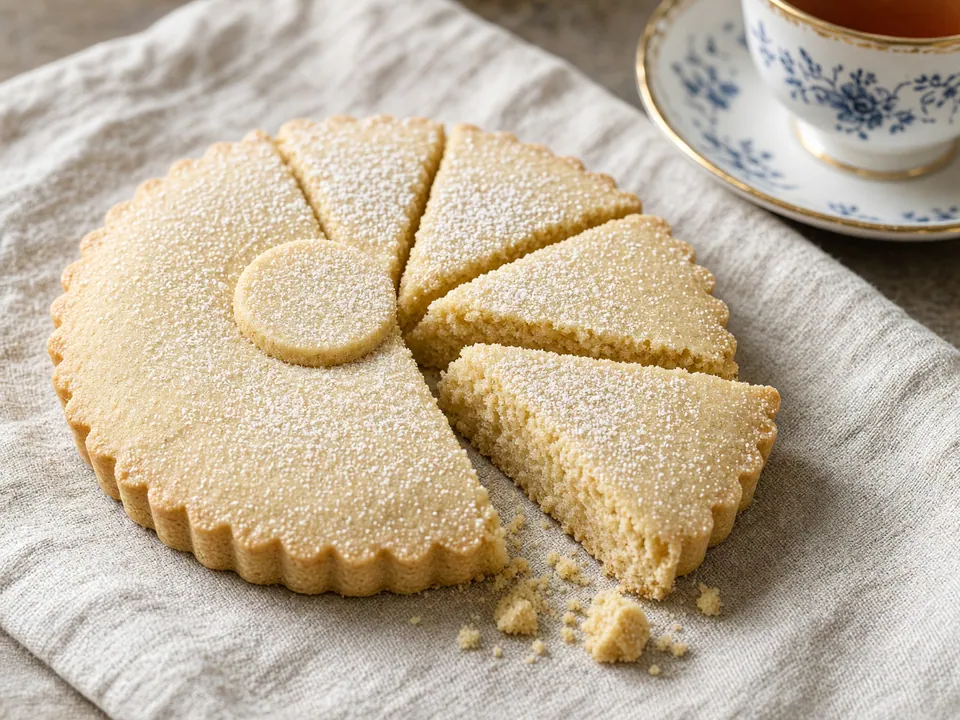
Petticoat tails are Scotland's classic shortbread, baked as one flat round with a fluted edge and cut into eight wedges, a small circle taken from the middle so the shape is said to resemble a panelled underskirt. The dough is only butter, sugar and flour — often with a little rice flour or cornflour for crunch — so it bakes pale gold, snaps cleanly and then melts. They are eaten with tea and whisky, and are a fixture of New Year hospitality.
Petticoat Tails
Petticoat Tails
Pronounced PET-ih-koht taylz
- Serves
- 8
- Prep
- 20 min
- Cook
- 45 min
- Total
- 1 hr 5 min
- Level
- Easy
Also nut-free and egg-free.
Allergens: contains gluten, milk. Check labels on packaged ingredients.
Ingredients
Amounts are scaled. Cooking times and pan sizes stay the same.
Method
Beat the softened butter and caster sugar with a wooden spoon or electric mixer for 3–4 minutes, until pale, fluffy and no longer gritty between your fingers.
Sift in the plain flour, cornflour and salt, then mix with a knife and finish with your hands until it just comes together as a soft, crumbly dough — stop as soon as there are no dry patches.
Pat the dough into a flat disc, wrap it and chill for 30 minutes, until firm but not rock hard.
Roll out on a lightly floured surface to a round about 1/4 inch (6 mm) thick and 8 inches (20 cm) across, then lift it onto a parchment-lined baking sheet.
Pinch the edge all the way round into a neat fluted rim, then prick the surface generously with a fork.
Cut a small circle about 1 1/2 inches (4 cm) wide from the centre, then score the ring into 8 even wedges with a sharp knife, cutting only halfway through the dough.
Chill the round for 15 minutes while the oven heats to 325°F (160°C) — firm dough holds the fluting and the cut lines cleanly.
Bake for 40–45 minutes, until pale gold, set and just faintly browned at the edges; it should smell nutty but not dark.
Dust with the extra caster sugar and re-cut the wedge lines while warm, then leave on the tray until completely cold and firm before breaking along the scores.
Regional variants
The same dough is also shaped as fingers, small rounds or a thick bannock. A richer Pitcaithly bannock adds chopped almonds and candied peel to the mixture.
Cook's notes
- Work the dough as little as possible — over-handling makes shortbread tough instead of short and crumbly.
- Cornflour or rice flour gives the characteristic sandy crunch; all plain flour works but the texture is less crisp.
- If the edges start to colour deeply, lay a sheet of parchment loosely over the top rather than lowering the heat.
Serve with
A pot of strong tea or a dram of whisky; often offered with afternoon tea and at New Year.
Make ahead and storage
Keeps 1 week in an airtight tin; the dough freezes for 2 months and the baked shortbread for 1 month.