Japanese Hot Spring Eggs (Onsen Tamago)
温泉卵 Onsen tamagoSay it: OHN-sen tah-MAH-goh
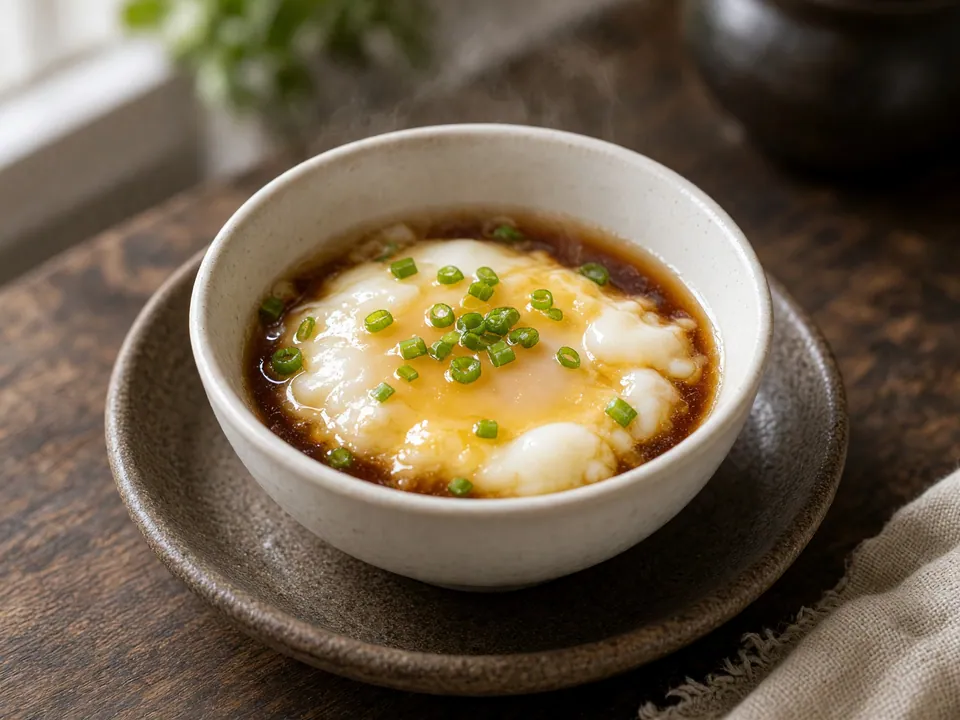
Onsen tamago are Japanese hot-spring eggs, gently cooked in their shells in water around 70°C until the white is barely set and the yolk turns soft and custard-like. Despite the name, they are easy to make at home with a thermometer and a pot. They are eaten for breakfast or as a small appetizer, often chilled and served in a warm dashi-soy broth with scallions. The appeal is textural: silky, trembling egg against a savory, slightly sweet broth.
Japanese Hot Spring Eggs (Onsen Tamago)
温泉卵, Onsen tamago
Pronounced OHN-sen tah-MAH-goh
- Serves
- 4
- Prep
- 5 min
- Cook
- 22 min
- Total
- 27 min
- Level
- Easy
Ingredients
Amounts are scaled. Cooking times and pan sizes stay the same.
Eggs and cooking bath
Dashi-soy broth
Method
Fill a large pot with the 8 cups (1.9 L) water and heat over medium until it reaches 158°F (70°C). Keep a thermometer in the water and adjust the heat so it stays between 155°F and 165°F (68–74°C).
Gently lower the eggs into the water with a slotted spoon. Cover the pot and cook for 22 minutes, checking the temperature every few minutes and adjusting the heat as needed to keep it steady.
Meanwhile, make the broth. combine the dashi, soy sauce, mirin, and sugar in a small saucepan. Warm over low heat, stirring until the sugar dissolves, about 2 minutes; do not let it boil, then set aside.
When the eggs are done, transfer them with a slotted spoon to the ice water and chill for 2 minutes to stop the cooking.
Crack each egg into a small bowl or cup; the white should be barely set and the yolk soft and custard-like.
Spoon the warm dashi-soy broth around the eggs, garnish with the scallions, and serve immediately.
Regional variants
Serve the eggs over hot rice or udon, or add a little grated ginger or yuzu zest to the broth. Some cooks use mentsuyu diluted with dashi instead of the soy-mirin mixture.
Cook's notes
- Use a kitchen thermometer; onsen tamago depends on a steady low temperature more than exact timing.
- Start with eggs straight from the refrigerator and lower them gently to avoid cracking.
- Kombu dashi makes a vegetarian version; regular dashi contains bonito flakes.
Serve with
Steamed rice, udon, or a Japanese breakfast spread with pickles and miso soup.
Make ahead and storage
The broth can be made up to 3 days ahead and refrigerated; cook the eggs just before serving.