Vietnamese Square Sticky Rice Cake (Bánh Chưng)
Bánh chưng Say it: bahn chung
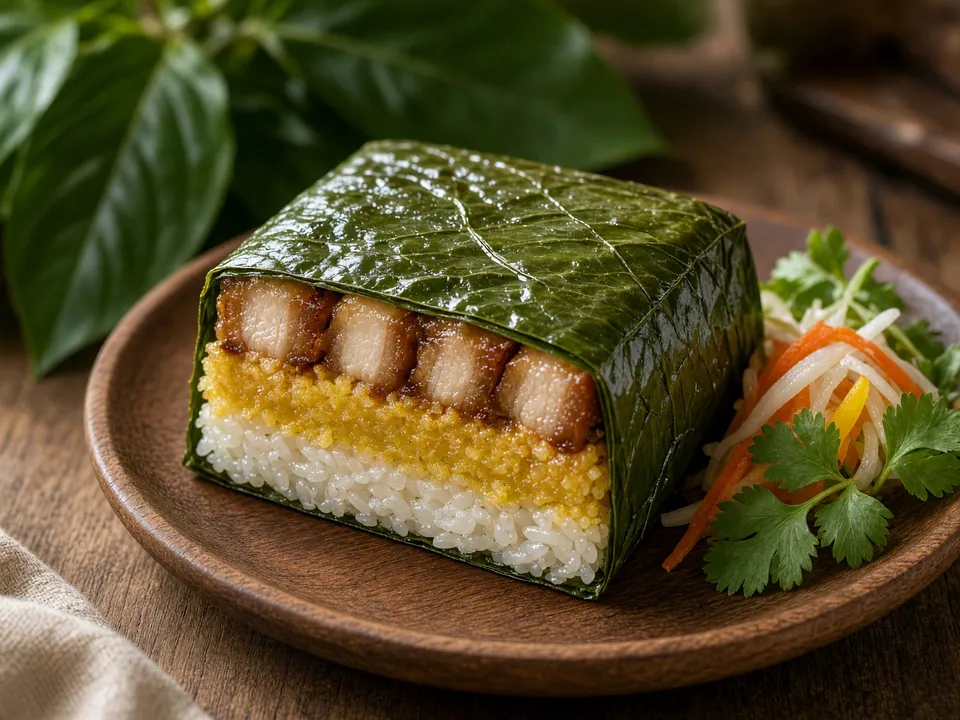
Bánh chưng is a traditional square sticky rice cake eaten throughout Northern Vietnam during Tết, the Lunar New Year. Made from glutinous rice, mung beans, and seasoned pork belly, it is wrapped in dong leaves and slowly boiled for many hours. The result is a dense, savory cake with a subtle aroma from the leaves, symbolizing earth and gratitude for the harvest. Families gather to prepare it together, and slices are enjoyed with pickled vegetables and Vietnamese sausage.
Vietnamese Square Sticky Rice Cake (Bánh Chưng)
Bánh chưng
Pronounced bahn chung
- Serves
- 4
- Prep
- 1 hr
- Cook
- 6 hr
- Total
- 7 hr
- Level
- Medium
Also nut-free and egg-free.
Allergens: contains fish. Check labels on packaged ingredients.
Ingredients
Amounts are scaled. Cooking times and pan sizes stay the same.
Method
Soak the glutinous rice in cold water for at least 6 hours or overnight. Soak the mung beans separately in cold water for 4 hours.
Drain both the rice and mung beans thoroughly. Mix the mung beans with ½ teaspoon salt.
Season the pork belly pieces with the remaining salt, black pepper, fish sauce, and sugar. Let marinate for 30 minutes.
To assemble one cake, lay two dong leaves shiny-side down in a cross shape inside a 6-inch (15 cm) square mold or directly on the counter. Add a ½-inch (1 cm) layer of rice, pressing it firmly into an even square.
Spread a thick layer of mung beans over the rice, then place 2-3 pieces of pork belly in the center. Cover the pork completely with another layer of mung beans followed by a final layer of rice, pressing each layer down firmly.
Fold the leaves tightly over the rice to form a neat square package. Wrap with additional leaves if needed for full coverage, then tie securely with kitchen twine in both directions to hold the square shape.
Place the wrapped cakes in a large stockpot. Cover with water by 2 inches (5 cm) and bring to a boil. Reduce to a gentle simmer and cook for 5-6 hours, adding hot water as needed to keep the cakes submerged.
Remove the cakes and place them on a tray with a heavy weight on top. Let cool completely for several hours or overnight until firm. The cake is ready when it holds its shape when sliced.
Regional variants
In Southern Vietnam, the round version called bánh tét uses the same ingredients but is shaped into a cylinder and often includes candied winter melon in the sweet variation. Modern home cooks sometimes add black beans or reduce the pork for lighter versions.
Cook's notes
- Dong leaves give the most authentic flavor and aroma; banana leaves are an acceptable substitute but will be milder.
- Boil the cakes gently; a hard boil can cause the leaves to burst and the rice to become waterlogged.
- The long boiling time is essential to fully cook the dense cake; do not shorten it.
Serve with
Pickled mustard greens (dưa chua), Vietnamese sausage (chả lụa), and fresh herbs. Serve at room temperature or lightly pan-fried.
Make ahead and storage
Bánh chưng keeps well wrapped in the refrigerator for up to 2 weeks or can be frozen for 3 months. Reheat by boiling again for 30 minutes or frying slices until crisp.