Lithuanian Angel Wings (Žagarėliai)
Žagarėliai Say it: zha-ga-REL-yai
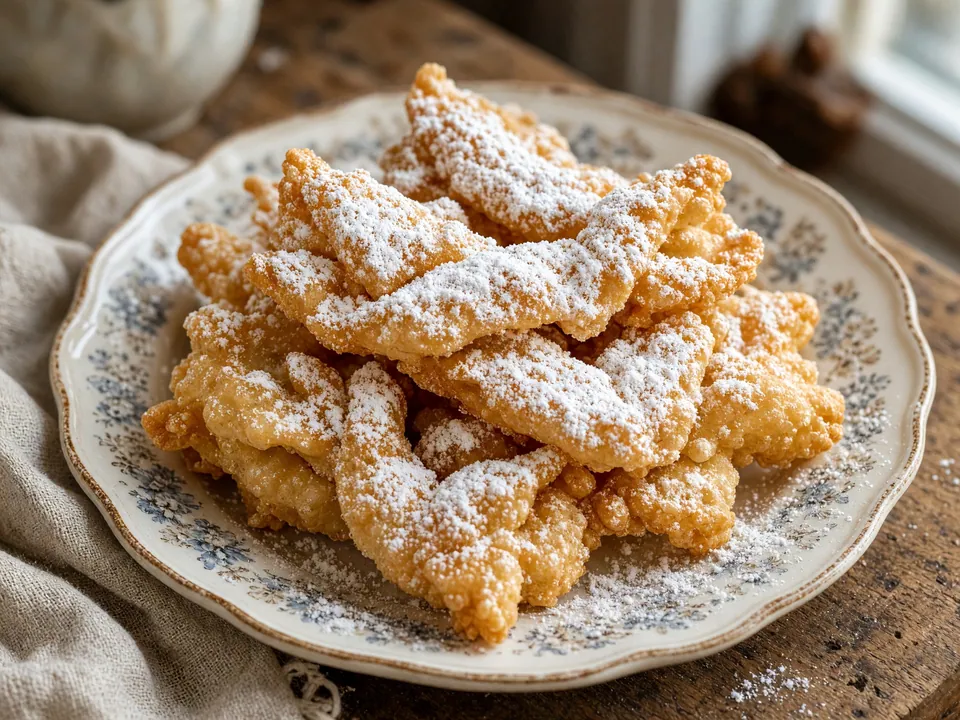
Žagarėliai, also known as chrustai or Lithuanian angel wings, are delicate, crisp fried pastries shaped into thin twisted ribbons or bows. These treats appear at Christmas, Easter, weddings, and family celebrations across Lithuania. Made from a simple dough enriched with sour cream and egg yolks, they are rolled paper-thin, cut, twisted, and deep-fried until golden and brittle, then generously dusted with powdered sugar. Their light, airy crunch and subtle sweetness make them a festive favorite that melts in the mouth.
Lithuanian Angel Wings (Žagarėliai)
Žagarėliai
Pronounced zha-ga-REL-yai
- Serves
- 6
- Prep
- 45 min
- Cook
- 20 min
- Total
- 1 hr 5 min
- Level
- Medium
Also nut-free.
Allergens: contains gluten, milk, egg. Check labels on packaged ingredients.
Ingredients
Amounts are scaled. Cooking times and pan sizes stay the same.
Method
In a large bowl, whisk together the sour cream, egg yolks, granulated sugar, rum or brandy if using, salt, and vanilla until smooth and well combined.
Gradually stir in the flour until a soft dough forms. Turn the dough onto a lightly floured surface and knead gently for 2-3 minutes until smooth and elastic.
Divide the dough into 3 equal portions. Keep the unused portions covered with a towel. Roll the first piece very thinly, about 1/16 inch (1.5 mm) thick, into a large rectangle.
Using a fluted pastry wheel or sharp knife, cut the rectangle into strips about 1 1/2 inches (4 cm) wide by 4-5 inches (10-12 cm) long. Cut a 1-inch (2.5 cm) slit lengthwise in the center of each strip, then pull one end through the slit to form a twisted bow shape.
Place the shaped pastries on a lightly floured tray or parchment while you repeat the process with the remaining dough.
Pour oil into a deep heavy pot to a depth of 3 inches (8 cm) and heat to 350°F (175°C). Test with a small scrap of dough; it should rise immediately and sizzle gently.
Fry 3-4 pastries at a time for 45-60 seconds per side, turning once with a slotted spoon, until they are pale golden and the edges look crisp and brittle. Avoid letting them darken too much.
Remove with a slotted spoon and drain on paper towels. Let the oil return to temperature between batches.
Cool the pastries completely, then dust both sides generously with powdered sugar before serving.
Regional variants
Some Lithuanian cooks add grated lemon zest to the dough for a fresh note, while others substitute vodka for the rum. Similar pastries appear across the Baltic region and in Poland as chrust or faworki with slight variations in flavoring.
Cook's notes
- Roll the dough as thinly as possible; the characteristic crisp, light texture disappears if the pieces are too thick.
- Keep shaped pastries covered with a towel to prevent them from drying out while you finish the rest.
- Fry in small batches and maintain steady oil temperature for even color and crispness.
Serve with
Hot tea, coffee, or a glass of cold milk.
Make ahead and storage
The dough can be prepared and refrigerated up to 24 hours ahead. Fry the same day for best crispness. Store cooled pastries in an airtight container at room temperature for 1-2 days.