Steamed Fish Dumplings (Siomay Bandung)
Siomay Bandung Say it: see-oh-MAY BAHN-doong
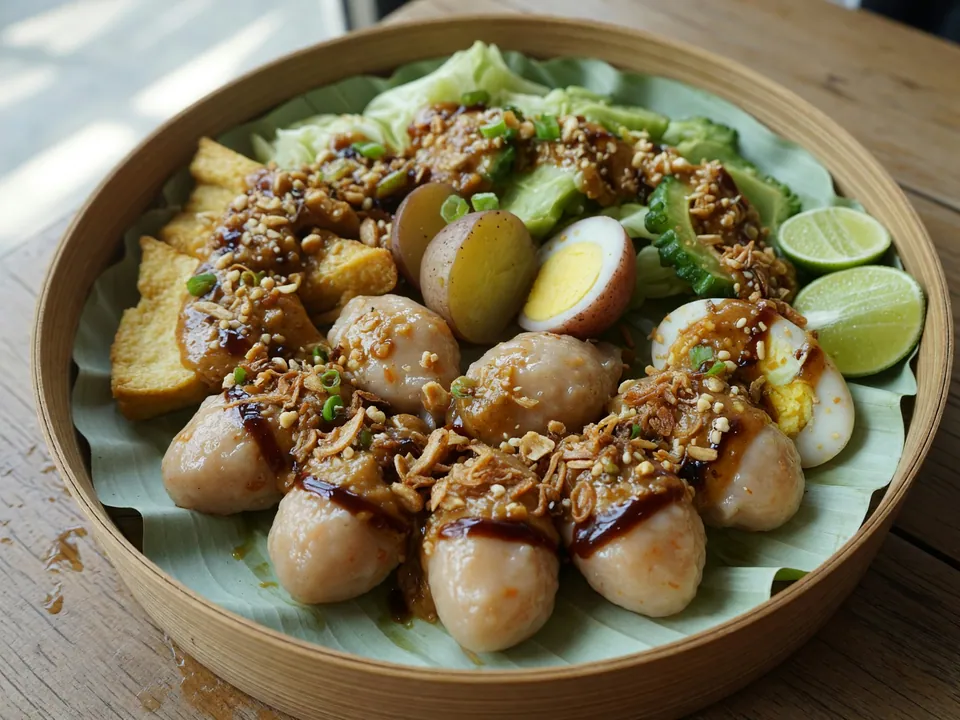
Siomay Bandung is West Java's beloved street-food version of steamed fish dumplings. Unlike Cantonese wrapped dim sum, these are soft, springy quenelles of ground mackerel and tapioca, steamed over cabbage and served with tofu, potatoes, hard-boiled eggs and often bitter melon. The finishing spoonful of warm peanut sauce — sweet, salty, tangy and mildly spicy — ties everything together. It is eaten as a snack or light meal from wheeled carts, and at home it makes a satisfying, shareable platter with rice or rice cakes.
Steamed Fish Dumplings (Siomay Bandung)
Siomay Bandung
Pronounced see-oh-MAY BAHN-doong
- Serves
- 4
- Prep
- 40 min
- Cook
- 30 min
- Total
- 1 hr 10 min
- Level
- Medium
Allergens: contains gluten, fish, egg, peanut, soy. Check labels on packaged ingredients.
Ingredients
Amounts are scaled. Cooking times and pan sizes stay the same.
Fish dumplings
Peanut sauce
Accompaniments and serving
Method
Put the fish, garlic, salt, sugar and white pepper in a food processor. Pulse until the fish forms a smooth, sticky paste, scraping down the sides once or twice. Add the egg and pulse just until mixed.
Scrape the paste into a bowl. Add the scallions, then fold in the tapioca starch in three additions, alternating with the ice-cold water, mixing in one direction until the paste is very thick, glossy and holds a soft peak. Cover and refrigerate for 15 minutes.
For the peanut sauce, place the peanuts, garlic, chilies, palm sugar, tamarind, salt and the 1 cup (240 ml) warm water in a blender. Blend until completely smooth. Heat the oil in a small saucepan over medium-low heat, pour in the peanut mixture and cook, stirring often, for 8–10 minutes until the sauce thickens, darkens slightly and oil beads appear at the edges. Thin with a little extra water if needed and keep warm.
Bring a large steamer or pot fitted with a steamer basket to a boil. Put the potatoes and bitter melon, if using, in the steamer along with 4 of the cabbage half-leaves and steam for 8 minutes over medium-high heat.
Meanwhile, arrange the remaining 4 cabbage half-leaves in a shallow heatproof plate or a second steamer basket. With wet hands or two spoons, shape the chilled fish paste into 16–18 oval quenelles, about 2 inches (5 cm) long, and set them on the cabbage leaves in a single layer.
Place the dumpling plate or basket in the steamer, above or next to the vegetables, and steam for 15–18 minutes, until the dumplings are firm, springy and cooked through. Add the tofu and hard-boiled eggs for the final 5 minutes to heat through.
Arrange the dumplings, cabbage, tofu, potatoes, bitter melon and eggs on a serving platter. Spoon the warm peanut sauce generously over the top, drizzle with kecap manis and scatter with fried shallots. Serve with lime wedges.
Regional variant: Batagor (Baso Tahu Goreng)
Shape the same fish paste into flat discs or spread it over tofu pieces, then deep-fry at 350°F (175°C) until golden and crisp. Drain, cut into pieces and serve with the same peanut sauce, kecap manis and lime. The result is crisp outside and springy inside, often with fried wonton skins added.
Cook's notes
- Keep the fish paste very cold while mixing; this helps it stay springy rather than crumbly.
- If the dumpling paste is too soft to shape, chill it for another 10 minutes or work in an extra tablespoon of tapioca starch.
- For a smoother dumpling, you can push the fish mixture through a sieve, but a food processor works well for home cooking.
Serve with
Steamed rice or lontong (rice cakes), plus wedges of lime; often served with a hot glass of sweet tea or iced tea.
Make ahead and storage
The fish paste can be refrigerated for up to 4 hours before steaming. Steamed siomay keep for 2 days refrigerated; reheat gently in a steamer or microwave, adding a splash of water.