Bavarian Roast Pork (Schweinebraten)
Schweinebraten Say it: SHVINE-brah-ten
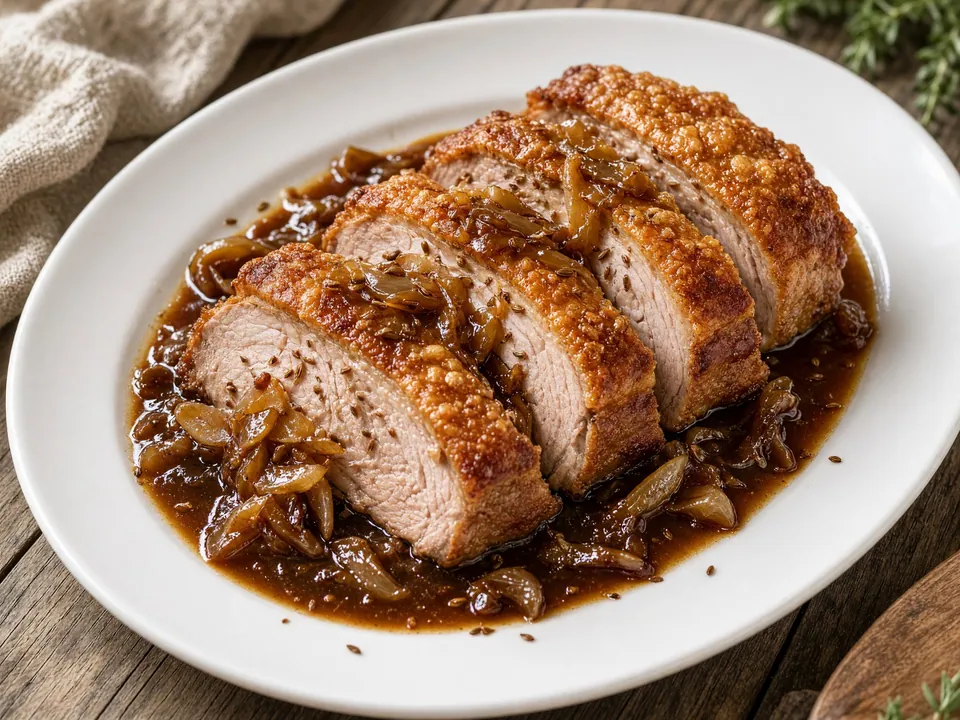
Schweinebraten is a beloved Sunday roast from Bavaria, Germany. A generous cut of pork shoulder or loin is slow-roasted until the meat is fork-tender and the skin or fat cap forms a crispy, crackling crust. Flavored simply with caraway, mustard, and dark beer or broth, it delivers rich, savory depth with a hint of sweetness from the caramelized onions. It is traditionally served at family gatherings, beer gardens, and festivals alongside hearty sides that soak up the flavorful gravy.
Bavarian Roast Pork (Schweinebraten)
Schweinebraten
Pronounced SHVINE-brah-ten
- Serves
- 6
- Prep
- 25 min
- Cook
- 3 hr
- Total
- 3 hr 25 min
- Level
- Medium
Also nut-free and egg-free.
Allergens: contains gluten. Check labels on packaged ingredients.
Ingredients
Amounts are scaled. Cooking times and pan sizes stay the same.
Method
Preheat the oven to 425°F (220°C). Pat the pork dry with paper towels. Score the fat cap in a diamond pattern without cutting into the meat.
Rub the entire roast with mustard, then generously season with crushed caraway seeds, salt, and pepper. Let it sit at room temperature for 20 minutes.
Heat the oil in a large roasting pan over medium-high heat on the stovetop. Sear the pork on all sides until well browned, about 8–10 minutes. Remove the pork and set aside.
Add the sliced onions and smashed garlic to the pan. Cook for 3–4 minutes until the onions begin to soften and pick up color.
Place the seared pork on top of the onions. Add the bay leaves and pour in 1 cup (240 ml) of the dark beer or broth.
Transfer the pan to the oven and roast at 425°F (220°C) for 20 minutes to start crisping the fat.
Reduce the oven temperature to 325°F (160°C). Continue roasting for 2–2½ hours, basting every 30 minutes with the remaining beer or broth and pan juices. The pork is done when the internal temperature reaches 195°F (90°C) and the meat pulls apart easily.
If the crust is not yet deeply golden and crisp, increase the temperature to 425°F (220°C) for the final 10–15 minutes.
Remove the roast, tent loosely with foil, and rest for 15 minutes. Meanwhile, strain the pan juices, skim excess fat, and simmer to make a simple gravy, mashing some of the onions into it for thickness.
Slice the pork thickly against the grain and serve with the gravy.
Regional variants
Some regions add juniper berries or a touch of marjoram to the rub. In Franconia, the gravy is often thickened with a dark beer roux and served with potato dumplings (Klöße). Modern versions may include root vegetables roasted alongside the pork.
Cook's notes
- Ask your butcher for a cut with a good fat cap or rind; this is what creates the prized crispy crust (Kruste).
- If the crust softens during resting, return slices to a hot oven or broiler for a few minutes to recrisp.
- Dark German lager or Märzen gives the best flavor, but beef broth works well for a non-alcoholic version.
Serve with
Potato dumplings (Kartoffelklöße), braised red cabbage (Rotkohl), and a cold glass of Bavarian lager.
Make ahead and storage
The roast can be cooked 1 day ahead, cooled, and refrigerated. Reheat gently in a 300°F (150°C) oven with a splash of broth; the crackling will need a final blast under the broiler to recrisp.