Sheki Halva (Şəki halvası)
Şəki halvası Say it: sheh-KEE hal-vah-SUH
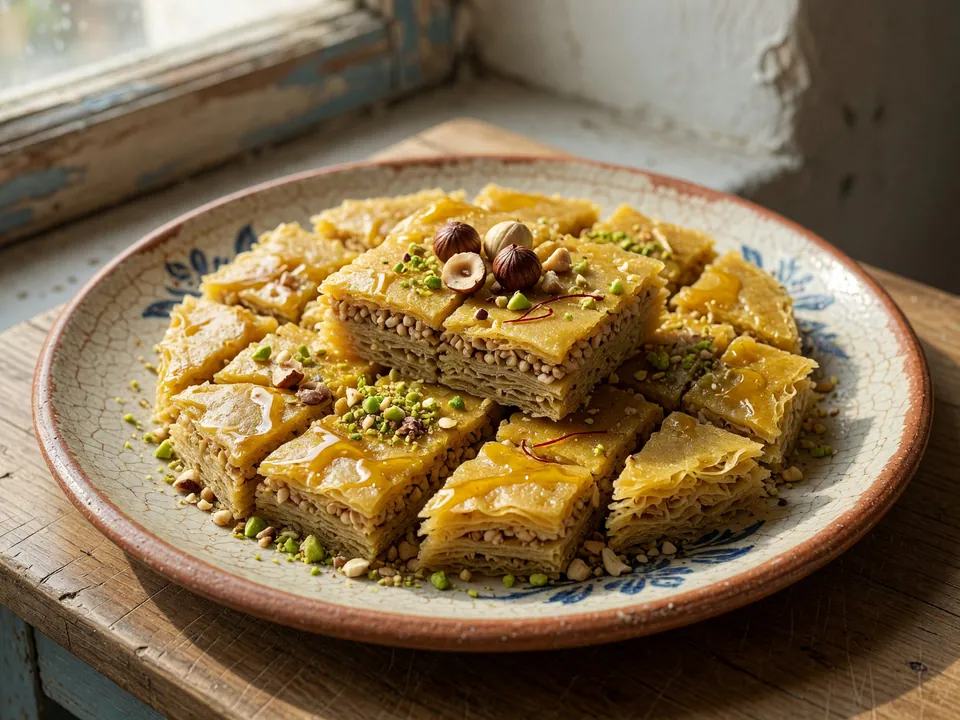
Sheki halva is a celebration sweet from Azerbaijan, served with black tea at holidays, weddings, and family gatherings. Its structure comes from rice-flour batter drizzled into paper-thin, openwork sheets, cooked on a griddle, then stacked with finely chopped hazelnuts. Warm saffron-cardamom syrup is poured over the stack and left to soak in until the layers are soft and glossy. What sets it apart is the tension between the fragile lattice, the buttery hazelnut richness, and the floral scent of saffron.
Sheki Halva (Şəki halvası)
Şəki halvası
Pronounced sheh-KEE hal-vah-SUH
- Serves
- 8
- Prep
- 50 min
- Cook
- 1 hr
- Total
- 1 hr 50 min
- Level
- Advanced
Also egg-free.
Allergens: contains milk, nuts. Check labels on packaged ingredients.
Ingredients
Amounts are scaled. Cooking times and pan sizes stay the same.
For the syrup
For the lacy sheets
For assembly
Method
For the syrup, put the sugar, water, saffron, and cardamom in a small saucepan. Set it over medium heat and boil, stirring until the sugar has dissolved. Lower the heat and simmer gently for 8–10 minutes, until the liquid is slightly thicker and lightly golden. Add the lemon juice, take the pan off the heat, and leave it to cool to just warm.
For the batter, whisk the rice powder and salt with the lukewarm water in a large bowl until no lumps remain. Whisk in 2 tbsp melted butter. The mixture needs to run freely from a squeeze bottle or a small funnel with a narrow opening; loosen with 1–2 tbsp extra water if necessary. Cover and set aside for 20 minutes.
While the batter rests, put the hazelnuts in a dry skillet over medium heat and shake the pan often until they smell toasted and their skins start to split. Tip them onto a clean towel, rub off the papery skins, and chop them finely. Leave aside.
To cook the sheets, warm a 9–10 inch (23–25 cm) nonstick skillet or griddle over medium-low heat and brush it lightly with melted butter. Fill a squeeze bottle or narrow-tipped funnel with batter. Quickly trace a thin crisscross lattice over the pan to make a 7–8 inch (18–20 cm) round. Cook for 1–2 minutes, until the sheet holds together, appears dry, and lifts at the edges; keep it pale rather than browned.
Slide the sheet onto a plate and continue with the rest of the batter, brushing the pan with butter before each one. Keep the cooked sheets stacked with parchment between them so they do not cling. The batch should give 8–10 sheets.
To build the halva, set one lacy sheet in the base of a 9-inch (23 cm) round cake pan or deep plate. Brush with warm saffron syrup and scatter over a thin layer of chopped hazelnuts. Add another sheet, brush with syrup, and add more nuts. Continue until the sheets and nuts are used up, ending with a sheet on top.
Spread any warm syrup that remains over the top and let it trickle down through the layers. Cover with parchment, set a flat plate or light weight on top, and press gently. Leave at room temperature for at least 2–3 hours, or overnight, so the syrup is absorbed throughout.
Slice into diamonds or wedges and serve at room temperature. The surface should be glossy, and the layers should stay together while remaining fragile.
Regional variant: Walnut Sheki halva (Şəki halvası qozlu)
Use the same weight of lightly toasted, finely chopped walnuts in place of the hazelnuts. Some households prefer this version because walnuts are common and produce a slightly softer, richer filling. Keep all other elements unchanged; this walnut variation is often made for autumn and winter celebrations.
Cook's notes
- A squeeze bottle with a fine nozzle gives the neatest lattice; a small plastic bag with one corner cut off is a workable substitute.
- Cook over low heat and brush the pan with butter before every sheet so the rice batter stays pale and releases cleanly.
- Allow the weighted rest — it lets the syrup even out and helps the layers firm enough for tidy slices.
Serve with
Offer it with strong black tea in small glasses, plus fresh or dried fruit alongside.
Make ahead and storage
Keep it covered at cool room temperature for 1–2 days, or chill it for up to 5 days; let it come back to room temperature before serving.