Poljica Chard Pie (Poljički soparnik)
Poljički soparnik Say it: POH-lyeech-kee soh-PAR-neek
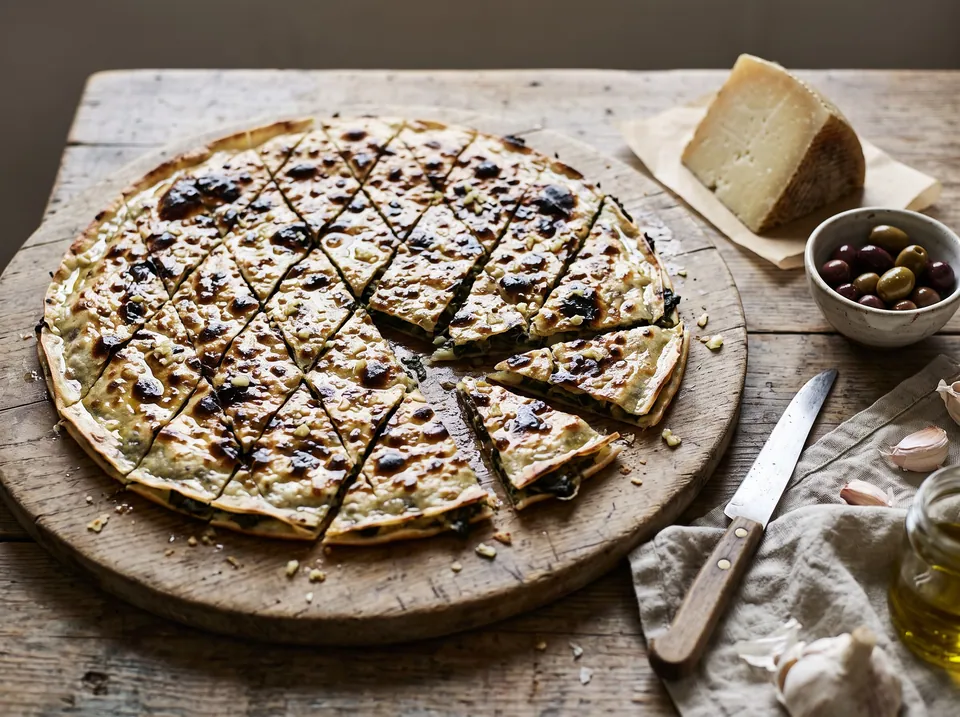
Soparnik comes from the Poljica area outside Split, where it is built as an almost translucent sheet of unleavened wheat dough around a heap of Swiss chard, red onion, parsley and olive oil. The pie goes onto a fiercely hot hearth and is done in a matter of minutes, after which garlic is rubbed over the crust and more olive oil is poured on. What was once plain farm fare now appears at wedding tables and feast days as a cool appetizer, sliced into diamonds and passed with cheese and pršut. If you are making it at home, the useful thing to know is that the filling looks far too abundant before it hits the heat; it wilts down while the crust crisps.
Poljica Chard Pie (Poljički soparnik)
Poljički soparnik
Pronounced POH-lyeech-kee soh-PAR-neek
- Serves
- 6
- Prep
- 40 min
- Cook
- 15 min
- Total
- 55 min
- Level
- Medium
Also nut-free and egg-free.
Allergens: contains gluten. Check labels on packaged ingredients.
Ingredients
Amounts are scaled. Cooking times and pan sizes stay the same.
Dough
Filling
To finish and bake
Method
For the dough, stir the flour and salt together in a wide bowl. Pour in the warm water a little at a time while mixing with a fork, then turn out onto a lightly floured counter and knead for about 5 minutes, until smooth and springy. Cover with a damp cloth and leave at room temperature for 30 minutes.
Rinse the chard and dry it thoroughly. Cut the leaves and thin stems into slim ribbons. Put the chard in a large bowl with the red onion, parsley, 1/3 cup olive oil and salt. Work the mixture with your hands for 1–2 minutes, just until the chard softens and reduces in bulk.
Set a pizza stone or a heavy upside-down baking sheet on the middle rack. Heat the oven to 500°F (260°C), or its highest setting, and leave it for at least 45 minutes so the surface becomes extremely hot.
Cut the dough into two equal pieces. On a lightly floured surface, roll one piece into a very thin round about 16 inches (40 cm) wide. Dust a pizza peel or an inverted baking sheet generously with cornmeal and place the first round on it. Scatter the chard filling over the dough in an even layer, leaving a 1–1.5 inch (2.5–4 cm) margin.
Roll the second piece to the same size. Wrap it around the rolling pin, lift it over the filling, and unroll it to cover the chard. Bring the lower edge up over the upper edge and pinch, twist or pleat it all the way around to make a rope-like border.
Slide the pie onto the hot stone or sheet. Bake for 10–14 minutes, until the top has blisters and golden patches and the rim is crisp. If the crust balloons in places, press it down gently with a clean cloth or spatula after a few minutes so it stays flat.
Take the pie out of the oven. While it is still hot, rub the minced garlic over the top if you are using it, then brush or pour the remaining 1/3 cup olive oil evenly across the surface. Leave it to cool for at least 10 minutes before cutting.
Cut the soparnik into diamonds roughly 4 inches (10 cm) across. Serve warm or at room temperature.
Regional variant: Hearth-baked soparnik (soparnik na kominu)
For a wood-fire version, get a clean hearth or a thick stone very hot over an open fire. Move the embers to one side, sweep the cooking surface, put the pie straight on it, and cover it with hot ash or embers; bake for 15–20 minutes. Lift it out carefully, dust off the ash, turn it over once, and finish with garlic and olive oil.
Cook's notes
- Older, sturdier chard leaves give the filling its customary bite; if you use tender young chard, hold back a little on the salt.
- The chard mixture will seem too bulky for the dough, but it shrinks as it bakes—spread it in an even layer and keep both dough rounds thin.
- No pizza stone? A cast-iron griddle or heavy baking sheet heated thoroughly will do; very high heat is what matters.
Serve with
Offer it at room temperature as a cold starter alongside sheep's cheese or a firm cheese and Dalmatian pršut; a young red wine also suits it.
Make ahead and storage
Wrap it and keep it at room temperature for up to 1 day. Warm it in a dry pan if you like, though it is traditionally eaten at room temperature.