Portuguese Custard Tarts (Pastéis de Belém)
Pastel de Belém Say it: pash-TEL deh beh-LAYM
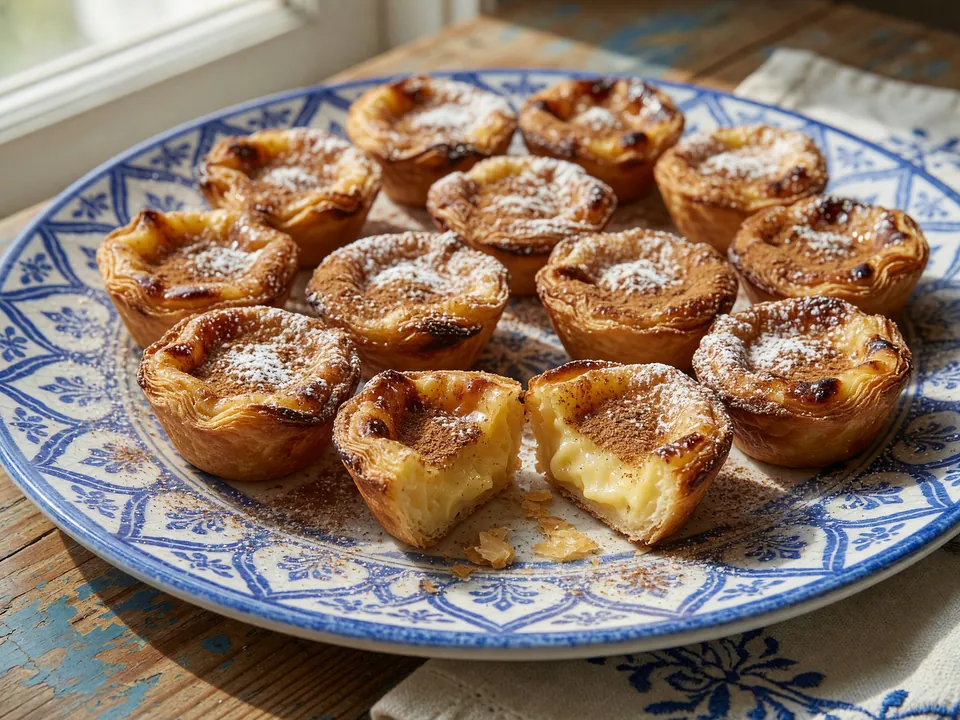
Pastel de Belém is Portugal's iconic custard tart from the riverside parish of Belém in Lisbon, forever linked with the Antiga Confeitaria de Belém. The shell is shatteringly crisp, layered puff pastry; the filling is a silky, egg-rich custard perfumed with lemon and cinnamon, baked at high heat until the top blisters into caramel-brown spots. It is eaten warm, dusted generously with cinnamon and powdered sugar, usually with coffee, and is the blueprint for every pastel de nata in the country.
Portuguese Custard Tarts (Pastéis de Belém)
Pastel de Belém
Pronounced pash-TEL deh beh-LAYM
- Serves
- 6
- Prep
- 30 min
- Cook
- 20 min
- Total
- 50 min
- Level
- Medium
Also nut-free.
Allergens: contains gluten, milk, egg. Check labels on packaged ingredients.
Ingredients
Amounts are scaled. Cooking times and pan sizes stay the same.
For the shells
For the custard
For serving
Method
Lightly grease a 12-cup muffin tin. On a lightly floured surface, roll the puff pastry sheet into a tight log from the long side. Cut the log into 12 equal rounds. Place each round cut side up in a muffin cup and press with your thumbs to line the bottom and sides, leaving a slight rim above the edge. Chill the prepared tin while making the custard.
In a small saucepan, combine the sugar, water, cinnamon stick, and lemon zest. Bring to a boil over medium-high heat, swirling gently to dissolve the sugar, then cook without stirring until slightly thickened and a candy thermometer reads 220°F (104°C), 3–4 minutes. Remove from the heat, lift out the cinnamon stick and lemon zest, and discard them.
In a medium saucepan, whisk the flour and salt with 1/4 cup (60 ml) of the cold milk until smooth. Whisk in the remaining 1 1/4 cups (300 ml) milk. Place over medium heat and cook, whisking constantly, until the mixture thickens enough to coat the back of a spoon, about 5 minutes; do not let it boil vigorously. Remove from the heat.
Slowly pour the hot sugar syrup into the hot milk mixture, whisking constantly until smooth. Let cool until just warm, about 5 minutes. In a separate bowl, whisk the egg yolks. Gradually whisk about 1/2 cup (120 ml) of the warm custard base into the yolks to temper them, then pour the yolk mixture back into the saucepan, whisking. Strain through a fine-mesh sieve into a measuring cup or pitcher with a spout.
Remove the muffin tin from the refrigerator. Divide the custard among the pastry shells, filling each about 3/4 full (about 1/4 cup/60 ml per tart). Do not overfill; leave a little rim of pastry exposed.
Place an oven rack in the upper third of the oven. Preheat the oven to 500°F (260°C), or 550°F (290°C) if your oven allows. Bake until the pastry is deeply golden and the custard is puffed with dark brown spots, 15–18 minutes. If the tops are not blistered after 15 minutes, switch on the broiler for 1 minute, watching closely.
Let the tarts cool in the tin for 5 minutes, then use a small offset spatula to transfer them to a wire rack. Serve warm or at room temperature, dusted with cinnamon and powdered sugar.
Regional variant: Pastel de Nata (Pastel de Nata)
This is the same custard tart found all over Portugal. Use the same filling and pastry, but bake in slightly smaller tins at the same high heat so the centers stay a little more liquid. Some home cooks replace the lemon zest with half a strip of orange zest or add 1/2 teaspoon vanilla extract to the custard for a softer flavor.
Cook's notes
- All-butter puff pastry gives the flakiest, richest shell; if only standard puff pastry is available, use it but expect a less buttery flavor.
- The custard should still tremble slightly in the center when you remove the tarts from the oven; it will finish setting as it cools. Overbaking makes it dry.
- To get the signature dark spots, don't fear high heat: place the tin near the top of the oven and watch carefully in the last few minutes.
Serve with
Serve warm with a bica (Portuguese espresso) or a glass of cold milk; dust generously with cinnamon and powdered sugar.
Make ahead and storage
The custard base can be made up to 1 day ahead and refrigerated; assemble and bake just before serving. Baked tarts are best the same day but can be reheated in a 350°F (175°C) oven for 5 minutes to re-crisp.