Filipino Coconut Bread Rolls (Pan de Coco)
Pan de coco Say it: pahn deh KOH-koh
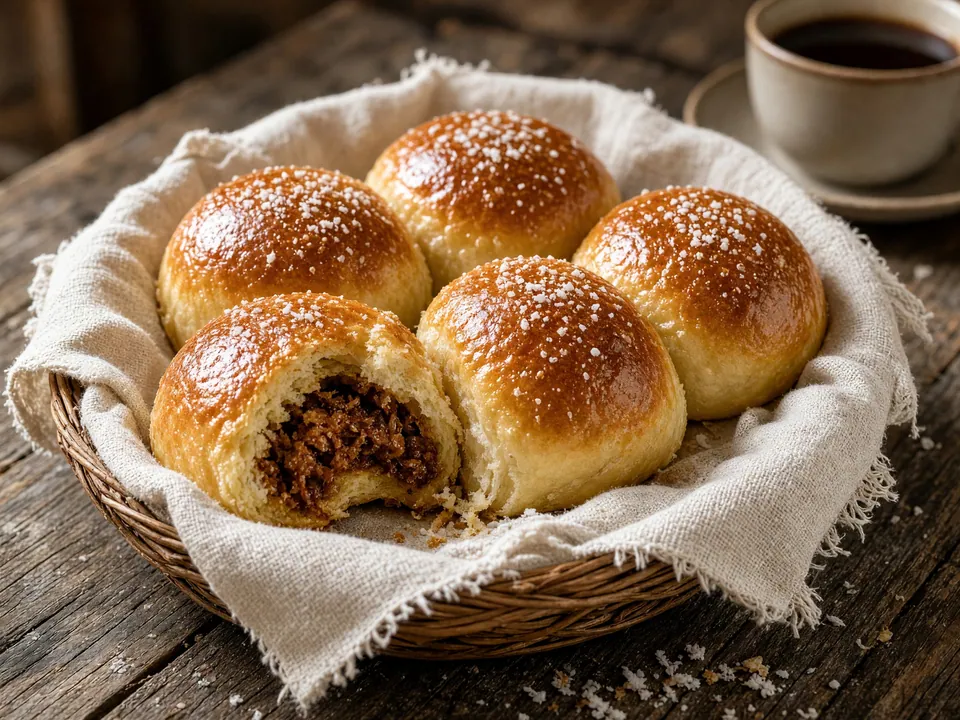
Pan de coco is a soft Filipino sweet roll stuffed with a dark, jammy filling of grated coconut simmered in brown sugar and coconut milk. It is a bakery staple across the Philippines, sold in panaderías alongside pan de sal and eaten at merienda — the afternoon snack — or at breakfast with coffee. The crumb is pillowy and lightly sweet, the center rich and caramel-scented, and the whole roll tastes of toasted coconut and muscovado.
Filipino Coconut Bread Rolls (Pan de Coco)
Pan de coco
Pronounced pahn deh KOH-koh
- Serves
- 12
- Prep
- 35 min
- Cook
- 20 min
- Total
- 55 min
- Level
- Medium
Also nut-free.
Allergens: contains gluten, milk, egg. Check labels on packaged ingredients.
Ingredients
Amounts are scaled. Cooking times and pan sizes stay the same.
Dough
Coconut filling
Egg wash
Method
Make the filling first. put the grated coconut, brown sugar, coconut milk, butter, salt and vanilla in a saucepan over medium heat. Cook, stirring almost constantly, for 8–10 minutes, until the sugar has melted, the liquid has reduced and the mixture is thick, glossy and pulls away from the pan in a mass. Spread it on a plate and let it cool completely.
In a large bowl, whisk the flour, instant yeast, granulated sugar and salt. Add the warm coconut milk and the egg and stir with a wooden spoon until a shaggy dough forms and no dry flour remains.
Turn the dough onto a lightly floured surface and knead for 6–8 minutes, until it comes together smoothly. Add the softened butter a little at a time, kneading it in fully, then knead 6–8 minutes more until the dough is soft, elastic and only slightly tacky; it should stretch thin enough to show light through it.
Shape the dough into a ball, place it in a lightly oiled bowl, cover and let it rise in a warm spot for 1 to 1 1/2 hours, until doubled in size and a finger pressed in leaves a dent that springs back slowly.
Punch the dough down, divide it into 12 equal pieces (about 65 g each) and roll each into a ball. Cover and rest for 10 minutes so the gluten relaxes.
Flatten each ball into a 3 1/2-inch (9 cm) round. Spoon about 1 heaped tablespoon (20 g) of the cooled filling into the center, gather the edges up over it and pinch the seam firmly closed, then roll between your palms into a smooth ball.
Set the rolls seam-side down on a parchment-lined baking sheet, spacing them 2 inches (5 cm) apart. Cover loosely and let them rise for 45–60 minutes, until puffy and nearly doubled.
Heat the oven to 350°F (175°C). Beat the egg with the milk and brush the tops of the rolls gently but evenly, taking care not to press down on the risen dough.
Bake for 18–22 minutes, until deep golden brown and the rolls sound hollow when tapped on the base. Cool on a rack for at least 10 minutes; they are best eaten slightly warm.
Regional variants
Some panaderías roll the shaped balls in fine dry breadcrumbs before the second rise, which gives a crisp, crackly crust. Others swap the brown sugar for dark muscovado, or add a drop of pandan extract to the filling for a grassy, fragrant note.
Cook's notes
- If you only have dry desiccated coconut, soak it in the 1/2 cup (120 ml) coconut milk for 10 minutes before cooking the filling so it stays moist.
- Cook the filling until it is genuinely dry and jammy — a wet filling steams through the dough and makes the rolls soggy or splits the seams.
- Weigh the dough portions if you can; even-sized balls rise and brown at the same rate and give a tidier bakery look.
Serve with
Hot coffee, tsokolate (thick Filipino hot chocolate) or ginger tea, for merienda or breakfast.
Make ahead and storage
Baked rolls keep 2 days in an airtight tin or freeze for up to 3 months; reheat at 300°F (150°C) for 5 minutes. Shaped, unbaked rolls can be covered and refrigerated overnight, then baked straight from cold with 5 extra minutes.