Roast Goose (Martinigans)
Martinigans Say it: MAR-tee-nee-gahns
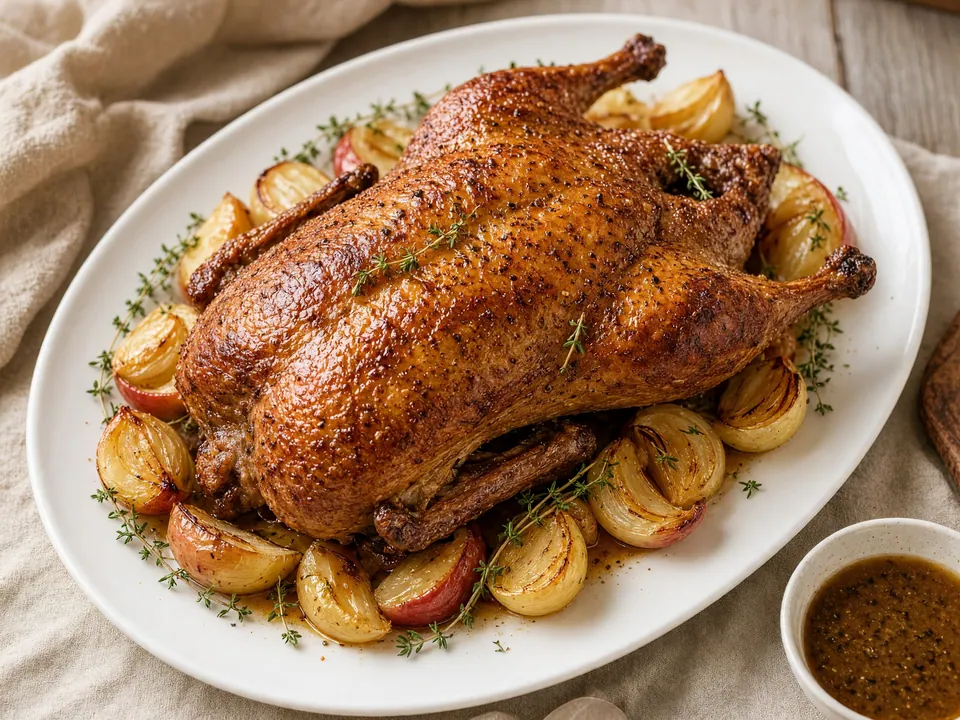
Martinigans is a traditional Austrian roast goose dish served on St. Martin's Day (November 11) throughout Austria, especially in Burgenland. Families gather for this festive meal where the goose is slowly roasted until the skin turns golden and shatteringly crisp while the meat stays succulent. Flavored simply with caraway, marjoram, and apples or chestnuts in the cavity, it delivers rich, savory flavor with a hint of sweetness. The crackling skin and juicy dark meat make it a highlight of the autumn and early winter table.
Roast Goose (Martinigans)
Martinigans
Pronounced MAR-tee-nee-gahns
- Serves
- 6
- Prep
- 30 min
- Cook
- 3 hr 30 min
- Total
- 4 hr
- Level
- Medium
Also nut-free and egg-free.
Allergens: none of the major allergens in the listed ingredients. Check labels on packaged ingredients.
Ingredients
Amounts are scaled. Cooking times and pan sizes stay the same.
Method
Remove any giblets from the goose cavity and pat the bird thoroughly dry inside and out with paper towels. Trim excess fat from the neck and cavity opening and reserve for rendering.
Mix the salt, crushed caraway seeds, marjoram, and black pepper. Rub this seasoning generously all over the goose, including inside the cavity. Let it rest at room temperature for 30 minutes or refrigerate uncovered overnight for crispier skin.
Preheat oven to 325°F (165°C). Place the quartered apples, onion, garlic, and bay leaves inside the goose cavity. Tie the legs together loosely with kitchen twine and tuck the wing tips under the body.
Place the goose breast-side up on a rack in a large roasting pan. Pour the white wine or stock into the bottom of the pan. Roast for 2½ to 3 hours, basting every 30 minutes with pan juices. If the skin browns too quickly, cover loosely with foil.
After 2 hours, increase the oven temperature to 400°F (200°C). Remove any foil and roast 20-30 minutes more until the skin is deep golden and very crisp and the internal temperature at the thickest part of the thigh reaches 175°F (80°C).
Transfer the goose to a carving board, tent loosely with foil, and rest 20 minutes. Meanwhile, skim fat from the pan juices and reduce the remaining liquid over medium heat if a simple sauce is desired.
Carve the goose by first removing the legs and wings, then slicing the breast meat. Serve the crisp skin in separate pieces so everyone gets some.
Regional variants
In some Austrian and German regions the goose is stuffed with chestnuts and breadcrumbs instead of apples and onion. Modern versions sometimes include a red cabbage or potato dumpling side that absorbs the rich gravy.
Cook's notes
- Save the rendered goose fat from the pan; it is excellent for roasting potatoes or making confit.
- Choose a young goose (under 6 months) for the most tender meat and best skin-to-meat ratio.
- Prick the skin all over with a needle or sharp fork before roasting to help fat render and skin crisp.
Serve with
Red cabbage braised with apples, potato dumplings (Knödel), and a glass of local white wine or beer.
Make ahead and storage
The goose can be roasted up to 2 hours ahead and held in a 170°F (75°C) oven; reheat skin under the broiler for crispness just before serving.