Norwegian Lefse (Lefse)
Lefse Say it: LEF-suh
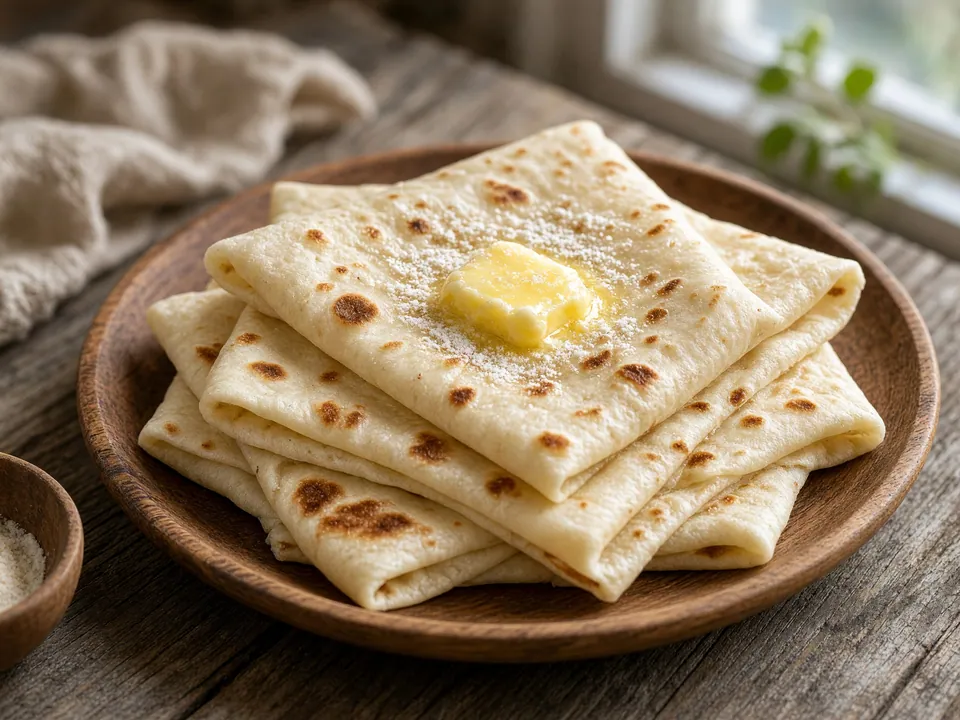
Lefse is a traditional Norwegian flatbread made from potatoes, flour, butter, and milk or cream. Soft, thin, and slightly sweet, it is a staple of Norwegian holiday tables, especially around Christmas. In homes across Norway it is rolled out paper-thin on a special grooved board and cooked on a hot griddle until it develops characteristic brown spots. Its delicate potato flavor and flexible texture make it perfect for spreading with butter and sugar or wrapping around savory fillings.
Norwegian Lefse (Lefse)
Lefse
Pronounced LEF-suh
- Serves
- 8
- Prep
- 1 hr
- Cook
- 30 min
- Total
- 1 hr 30 min
- Level
- Medium
Also nut-free and egg-free.
Allergens: contains gluten, milk. Check labels on packaged ingredients.
Ingredients
Amounts are scaled. Cooking times and pan sizes stay the same.
Method
Boil the potato chunks in a large pot of unsalted water until very tender, about 15-20 minutes. Drain well and return to the hot pot.
Mash the potatoes thoroughly until completely smooth with no lumps. Stir in the butter, heavy cream, salt, and sugar while the potatoes are still hot. Mix until the butter melts and everything is evenly combined.
Spread the mashed potato mixture on a large baking sheet or in a wide bowl and let it cool to room temperature, then cover and chill in the refrigerator for at least 2 hours or overnight.
When ready to cook, turn the chilled potato dough onto a floured surface and gradually knead in the 2 cups of flour until a soft, non-sticky dough forms. Divide into 16 equal balls.
Heat a large griddle or lefse grill to 400–425°F (205–220°C). On a well-floured pastry cloth or board, roll one dough ball into an extremely thin circle, about 12–14 inches (30–35 cm) across.
Carefully lift the rolled lefse with a lefse stick or a thin spatula and transfer it to the hot griddle. Cook for 45–60 seconds until small brown spots appear on the underside, then flip and cook the second side the same way.
Transfer the cooked lefse to a clean kitchen towel and cover to keep it soft and pliable. Repeat with the remaining dough balls, adding more flour to the board as needed.
Once cooled, fold each lefse in quarters or roll them up for storage.
Regional variants
In some regions of Norway, especially in the north, potato lefse may include a little more cream for extra tenderness. Sweet lefse is often spread with butter, cinnamon, and sugar, while savory versions are filled with smoked salmon, cured meats, or cheese.
Cook's notes
- Keep the dough chilled between batches; cold dough is much easier to roll thin without tearing.
- Use a grooved rolling pin (lefse pin) and a canvas-covered board if possible; they help achieve the signature thinness and prevent sticking.
- If the lefse tears while rolling, simply patch it with a small piece of dough and roll again.
Serve with
Butter and sugar, lingonberry jam, or savory fillings such as smoked salmon and cream cheese. Serve with coffee or milk.
Make ahead and storage
Lefse freezes beautifully. Stack cooled rounds between parchment paper, wrap tightly, and freeze up to 3 months. Thaw at room temperature and warm briefly on a dry skillet before serving.