Beijing Fried Sauce Noodles (Zhajiangmian)
炸酱面 zhá jiàng miànSay it: jah-jyang-myen
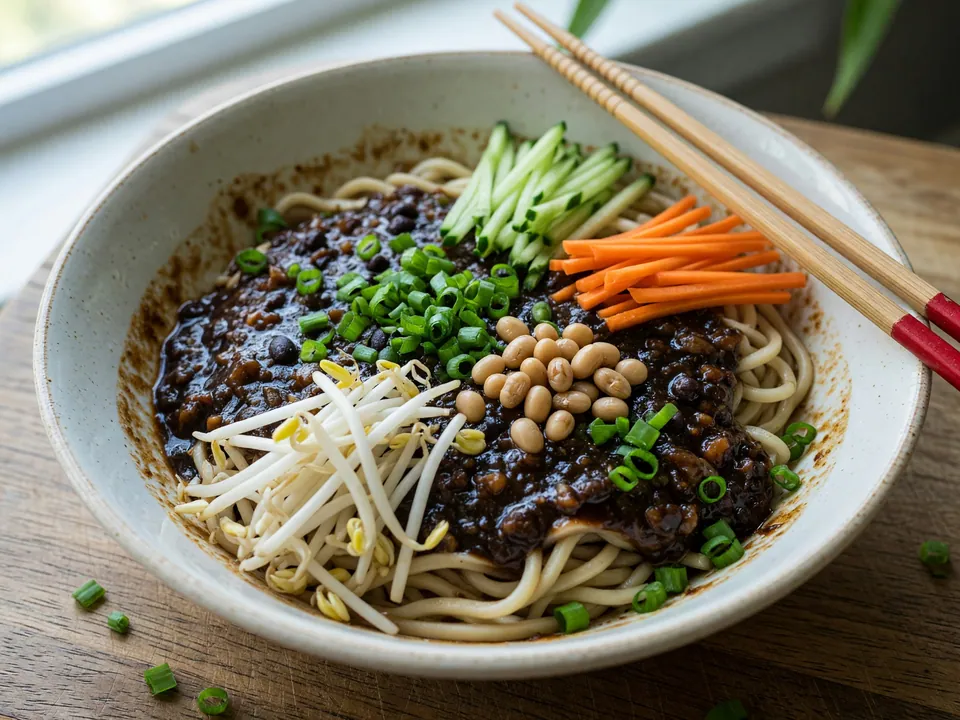
When diners twirl the thick wheat strands through the glossy, intensely savory pork and soybean paste, each bite delivers a rich explosion of umami that perfectly balances the refreshing crunch of cool vegetables. This practical one-bowl meal comes together quickly once the sauce is prepared, making it ideal for busy weeknights or casual gatherings.
Beijing Fried Sauce Noodles (Zhajiangmian)
炸酱面, zhá jiàng miàn
Pronounced jah-jyang-myen
- Serves
- 4
- Prep
- 40 min
- Cook
- 30 min
- Total
- 1 hr 10 min
- Level
- Medium
Also nut-free and egg-free.
Allergens: contains gluten, soy. Check labels on packaged ingredients.
Ingredients
Amounts are scaled. Cooking times and pan sizes stay the same.
For the sauce
For the noodles and toppings
Method
Combine the yellow soybean paste, sweet bean sauce, Shaoxing wine, sugar, and water in a small bowl and stir vigorously until the blend reaches a uniform consistency. Reserve this mixture for later.
Get all the vegetable accompaniments prepared ahead of time by slicing the cucumber and carrot into thin strips, immersing the mung bean sprouts in boiling water for 20 seconds before draining thoroughly, and setting out the cooked soybeans or edamame. Place everything on a serving platter.
Warm the oil inside a wok or spacious frying pan set to medium temperature. Introduce the cubed pork and sauté it while stirring from time to time until the edges turn golden brown and the fat has fully melted out, taking 6–8 minutes.
Incorporate the minced scallion whites along with the ginger into the pork mixture and cook briefly until their aromas are released, around 30 seconds. Add the prepared paste mixture and continue cooking over a reduced flame while stirring nonstop until the sauce grows darker, becomes thicker, and shows clear oil separation around the perimeter, roughly 5 minutes. Thin it slightly with 1–2 tablespoons of water if the texture turns overly dense.
While the sauce finishes cooking, boil the noodles in a big saucepan of water following the instructions on their packaging until they achieve a firm yet pleasant chew. Remove excess moisture by draining them completely.
Portion the steaming noodles evenly into four individual serving bowls. Ladle a substantial quantity of the prepared sauce atop each helping, then arrange attractive mounds of the cucumber strips, carrot strips, blanched sprouts, and soybeans over the top. Finish by scattering the saved scallion greens across each bowl and encourage guests to combine all components thoroughly prior to consuming.
Regional variant: Shandong-style Zhajiangmian (山东炸酱面)
Replace the yellow soybean paste entirely with sweet bean sauce (tianmianjiang) and limit the added water to only one or two tablespoons. This produces a sauce that tastes sweeter, appears deeper in color, and develops a shinier surface. Either diced or ground pork works equally well, and the frying process remains identical until oil separation occurs. Present alongside the identical selection of crisp vegetable garnishes.
Cook's notes
- Developing the sauce through unhurried cooking over gentle heat unlocks its fullest taste profile, so allow adequate time for the oil to visibly pull away from the paste.
- When the yellow soybean paste carries an especially high salt level, begin by incorporating a reduced quantity and fine-tune the flavor once the full sauce has been simmered and sampled.
- Traditional preparation relies on sturdy, elastic wheat noodles, so opt for fresh udon or freshly made pulled varieties whenever possible, though ordinary spaghetti serves adequately as an emergency substitute.
Serve with
Raw garlic cloves, extra cucumber spears, and a small bowl of light chicken or vegetable broth, with jasmine tea on the side.
Make ahead and storage
The fried sauce keeps in the fridge for up to 4 days; reheat gently with a splash of water. Prepared vegetables can be stored in ice water for a few hours.