Slava Bread (Slavski kolač)
Славски колач Slavski kolačSay it: SLAV-ski ko-LACH
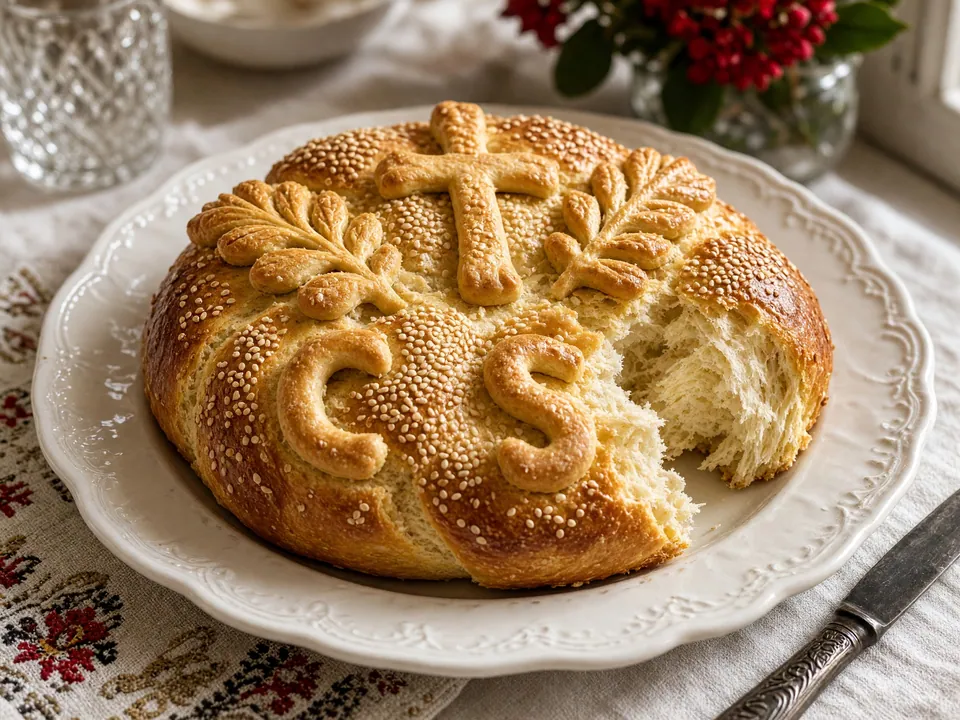
Slavski kolač is the ceremonial bread at the heart of Slava, Serbia’s unique family patron-saint celebration. Baked in every Serbian home on the saint’s feast day, this enriched, slightly sweet bread is decorated with intricate dough symbols representing faith, family and eternity. After the priest blesses it, the head of the household breaks the loaf by hand; everyone present shares a piece. Its soft, tender crumb and golden crust carry centuries of tradition and carry deep emotional meaning for Serbian families.
Slava Bread (Slavski kolač)
Славски колач, Slavski kolač
Pronounced SLAV-ski ko-LACH
- Serves
- 8
- Prep
- 30 min
- Cook
- 50 min
- Total
- 1 hr 20 min
- Level
- Medium
Also nut-free.
Allergens: contains gluten, milk, egg. Check labels on packaged ingredients.
Ingredients
Amounts are scaled. Cooking times and pan sizes stay the same.
Method
In a small bowl stir together the warm milk, yeast and 1 tablespoon of the sugar. Let stand 5–10 minutes until foamy.
In a large mixing bowl whisk the remaining sugar with the eggs until pale. Add the foamy yeast mixture and stir well.
Add 3 cups (375 g) of the flour and the salt. Mix until a shaggy dough forms, then pour in the melted butter. Continue adding the remaining flour until the dough pulls away from the sides but is still soft.
Turn the dough onto a lightly floured surface and knead 8–10 minutes until smooth, elastic and only slightly tacky. Form into a ball.
Place the dough in a lightly buttered bowl, cover with a clean towel and let rise in a warm spot for 1–1½ hours until doubled in size.
Punch down the dough and divide into three equal pieces. Set one piece aside for decorations. Roll the remaining two pieces into long ropes and braid them together. Coil the braid into a round loaf on a parchment-lined baking sheet, tucking the end underneath.
Roll the reserved dough into thin ropes, leaves, crosses or the traditional “C” and “S” monograms. Arrange them decoratively on top of the loaf, pressing gently to adhere. Cover loosely and let rise 30–40 minutes until puffy.
Preheat oven to 350°F (175°C). Brush the loaf evenly with the egg-yolk glaze. Sprinkle with coarse sugar or sesame seeds if desired.
Bake 45–50 minutes until deep golden brown and the bottom sounds hollow when tapped. If the decorations darken too quickly, cover loosely with foil for the last 10 minutes.
Cool completely on a wire rack before serving. The bread is traditionally broken by hand at the Slava table.
Regional variants
Some regions add a little grated lemon zest or a splash of rum to the dough. Modern home cooks sometimes shape the loaf in a round pan instead of free-form for a more uniform rise.
Cook's notes
- The dough should be soft and slightly sticky; resist adding too much extra flour or the bread will be dry.
- Traditional decorations include a cross, wheat stalks, grapes and the Cyrillic letters С and С for “Sveti Sava” or the family saint’s initial.
- Leftover Slava bread makes excellent toast or French toast the next day.
Serve with
Traditionally served with wheat koljivo, red wine and the family’s festive meal.
Make ahead and storage
The bread is best the day it is baked but can be wrapped tightly and frozen up to one month. Thaw at room temperature and warm briefly in a low oven before serving.